Our Memorial Torah Scroll: MST #1408
A Living Memory of the Jewish Community of Cheb (Eger), Bohemia
What Is a Memorial Scroll?
Kol Ami is home to a Czech Memorial Torah Scroll, MST #1408, on permanent loan from the Memorial Scrolls Trust (MST) in London. This scroll is what the MST calls an orphan scroll, one of more than 200 Czech Torah scrolls whose original town or original synagogue could not be identified. The scroll’s identifying tag was lost somewhere along its long journey. No one knows which community first prayed from it, danced with it, or wept over it. What we do know is that it survived. And we know that its survival took many hands.
MST #1408 itself keeps its secrets. Rabbi Moshe Druin, the sofer (scribe) who repaired it prior to the 2024 adult b’nei mitzvah service, declined to even attempt to date it. Its Atzei Chayim, the wooden rollers on which the parchment is wound, are not original; they were replaced somewhere along the way. Its script style, its parchment, and the fact that it is not a Vav scroll — one written so that each column of text begins with the Hebrew letter vav — together make its time and place of origin nearly impossible to identify. We will likely never find a satisfying answer as to where it came from. Yet the scroll has begun to give up a little. As Rabbi Malcolm Cohen shared with the congregation in April 2026, the scroll’s script mixes the Ashkenazi and Sephardic styles, a combination not seen in scrolls written in the last 250 years, which means MST #1408 is older than that. And a scroll written in both traditions, he explained, most likely came from the hand of a Kabbalist, a scribe versed in Jewish mysticism.
Because MST #1408 carries no name and no known origin, Kol Ami adopted Cheb (known in German as Eger) as its spiritual home. Cheb was one of the oldest and most historically significant Jewish communities in Bohemia, and its story reflects the full arc of Jewish life in Central Europe. Cheb’s Jewish community experienced centuries of flourishing, expulsion, and return; a vibrant modern congregation; and, ultimately, destruction at the hands of the Nazi regime.
In adopting Cheb, we gave this Torah scroll a community, and we gave that lost community a voice.
Sources
Memorial Scrolls Trust, “Scroll Origin Towns,” memorialscrollstrust.org; assessment of the sofer who repaired the scroll, relayed by Sue and Herb Cohn, as related by Sue Cohn to Susan-Marie Flanigan during a study session at the Cohns’ home; “Thank You to the Many Hands,” b’nei mitzvah remarks delivered at Kol Ami, May 18, 2024; Rabbi Malcolm Cohen, remarks at the Shabbat morning service with the Czech Torah, April 4, 2026, Kol Ami congregational notes.
The Story of the Czech Memorial Scrolls
How does a Torah scroll from Bohemia come to rest in Tucson, Arizona? The short answer: many hands.
The story begins in occupied Prague in 1942, with a remarkable act of cultural rescue. As the Nazis systematically destroyed Jewish life across Bohemia and Moravia, a dedicated group of curators at the Jewish Museum in Prague worked to gather Torah scrolls and religious objects from the emptied synagogues of the provinces into the relative safety of the museum. They cataloged each scroll meticulously, noting its origin and condition, working under dangerous conditions. Most of those curators were eventually deported to Theresienstadt (Terezín) and Auschwitz; only a few survived. Ultimately, the scrolls outlived the hands that initially saved them.
The scrolls remained in Prague through World War II and through the decades of communist rule in Czechoslovakia that followed. In 1963, the Czech government, through a state-run enterprise called Artia, offered the collection for sale. London art dealer Eric Estorick learned of the offer and brought it to the attention of Ralph Yablon, a British-Jewish philanthropist, who discussed it with Rabbi Harold Reinhart of Westminster Synagogue. After an expert examination of the scrolls in Prague by Professor Chimen Abramsky of University College London, Yablon generously funded their purchase. In February 1964, all 1,564 scrolls arrived at Westminster Synagogue’s Kent House in London.
What awaited those at Westminster Synagogue was staggering. Many scrolls were water-damaged, fire-scorched, nibbled by rodents, or otherwise badly deteriorated. Ruth Shaffer, who ran the scroll operation at Westminster Synagogue for nearly four decades and would later sign our own scroll’s letter of assignment, soon found the person who would restore them. An Orthodox scribe named David Brand knocked on the door of Westminster Synagogue and asked, in Yiddish, “Do you have any Torah scrolls that need repair?” Shaffer answered, “We have 1,564; come in!” Brand stayed for twenty-seven years, painstakingly restoring scroll after scroll.
Our scroll, MST #1408, is one of the orphans of that collection.
The Memorial Scrolls Trust (MST) was established as an independent charitable organization to care for the collection and to distribute scrolls (always on permanent loan, never sold) to Jewish communities, museums, and educational institutions around the world. In the six decades since 1964, most of the collection has left Kent House for new homes in the life of Jewish communities around the world, from North America to South Africa to the far South Pacific.
The Trust has documented 118 towns across Bohemia and Moravia from which the origins of its scrolls could be traced. A map produced by the Trust, “Where Our Scrolls Came From” (cartography and panel design by Helen Stirling Maps, 2020), plots all 118 numbered communities and shows the boundaries of the pre-war regions as they stood on September 30, 1938, the date of the Munich Agreement. Cheb is not among the 118: no surviving scroll in the collection could be traced back to it. That absence is part of what made our adoption possible; an orphan scroll and a town without a scroll could be joined to one another. Cheb sits at the westernmost edge of Bohemia, directly on the German border, and that geography is not incidental. The Nazi annexation of the Sudetenland in late September 1938 ended Cheb’s organized Jewish life almost immediately, well before the formal machinery of deportation that later reached communities deeper inside Czechoslovakia.
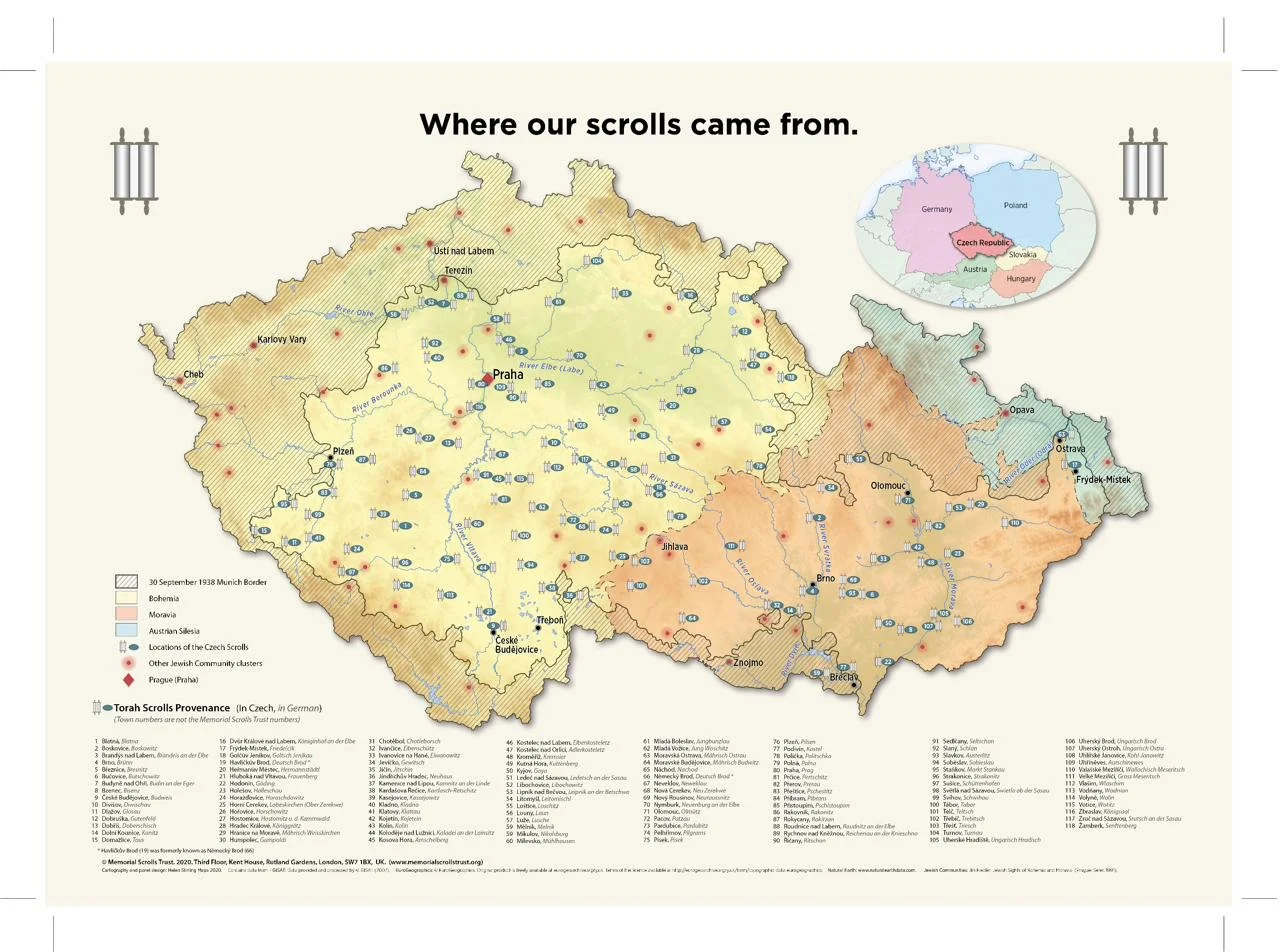
“Where Our Scrolls Came From”: the 118 Czech communities whose scrolls are in the Memorial Scrolls Trust collection. Cheb appears at the westernmost edge of Bohemia but is not among the 118; no surviving scroll could be traced to it. Cartography and panel design: Helen Stirling Maps, 2020. Courtesy of the Memorial Scrolls Trust.
Sources
Westminster Synagogue, “Memorial Scrolls Trust Museum,” westminstersynagogue.org; Memorial Scrolls Trust, “London,” memorialscrollstrust.org; Memorial Scrolls Trust, “The Scrolls,” memorialscrollstrust.org; Phyllis Braun, “Ceremony Honors Rescue of Holocaust Torah Scrolls,” Arizona Jewish Post, March 12, 2024; “Where Our Scrolls Came From,” map panel, Memorial Scrolls Trust, cartography by Helen Stirling Maps, 2020.
Our Scroll Comes to Kol Ami
Congregants Sue and Herb Cohn began the effort to obtain MST #1408 in October 1995. In March 1996, the Memorial Scrolls Trust (MST) in London assigned the scroll on permanent loan to Temple Sinai, their congregation in Lawrence, Long Island, New York. The Trust’s letter of assignment, signed by Joint Chairman and Trustee Ruth Shaffer, described the scroll as being “of emotional and sentimental consideration,” to be used “for religious and educational purposes.” The Cohns were instrumental in the endeavor, undertaken together with Sue’s sister and brother-in-law, Rhoda (née Crayne) and Val Yaverbaum, in memory and honor of their parents: Nettie (z”l) and Steven S. Crayne, Sylvia B. and Jerry Cohn, and Sally and Jesse Yaverbaum. When Temple Sinai’s president, Barry Mayer, and his wife, Denise, traveled to London in March 1996 to pick up the scroll, they expected to be able to choose one. They were told instead that they would receive the scroll presented to them, wrapped in paper, or no scroll at all. When MST #1408 landed in the United States, Temple Sinai’s Rabbi Paula Winnig led a brief service in John F. Kennedy Airport’s chapel to honor its arrival, with Herb, Sue, Rhoda, and Val present. A second service was later held at Temple Sinai with the entire congregation.
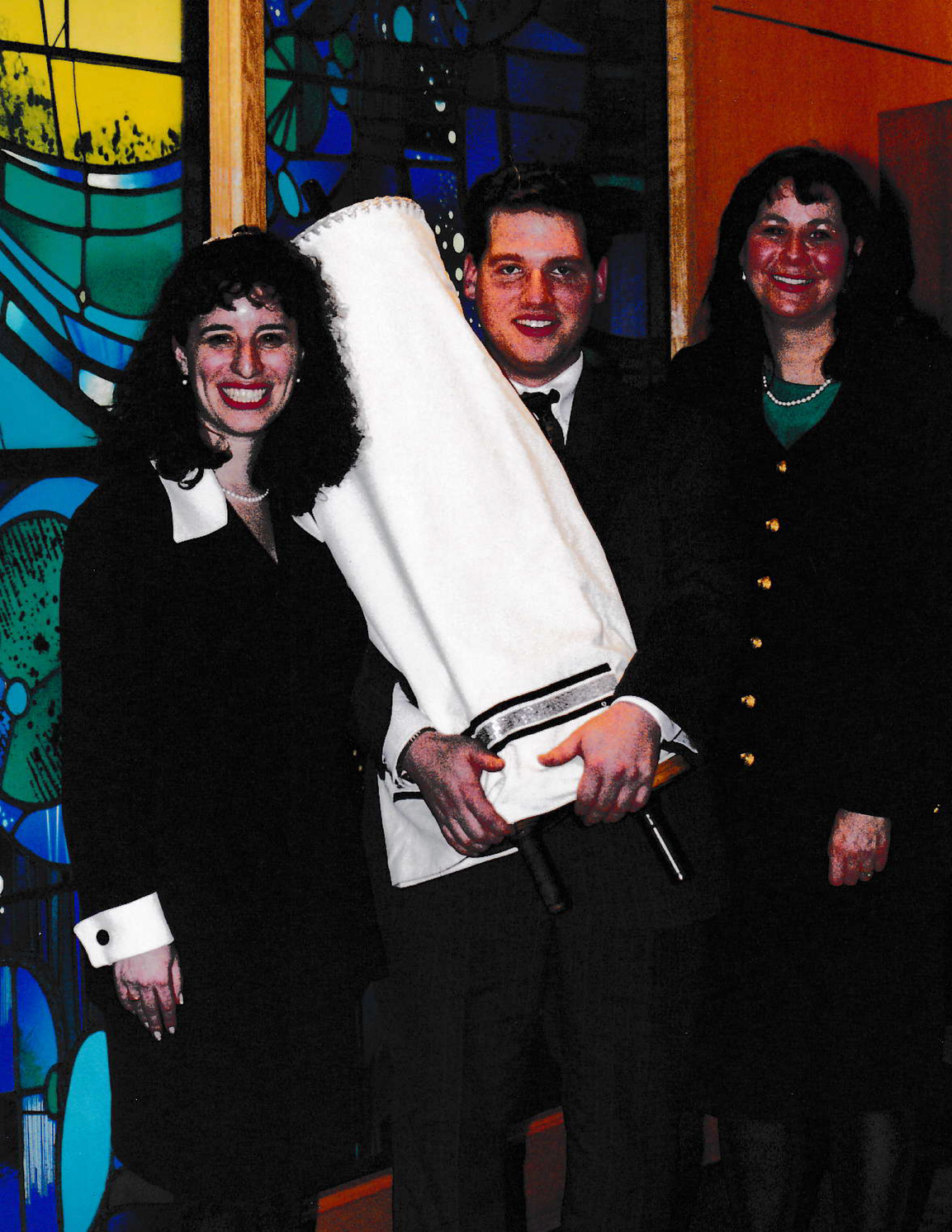
The scroll’s welcome at Temple Sinai in Lawrence, New York: Sue and Herb Cohn; Rhoda and Val Yaverbaum with their daughter Sara; congregation president Barry Mayer; and Temple Sinai clergy.
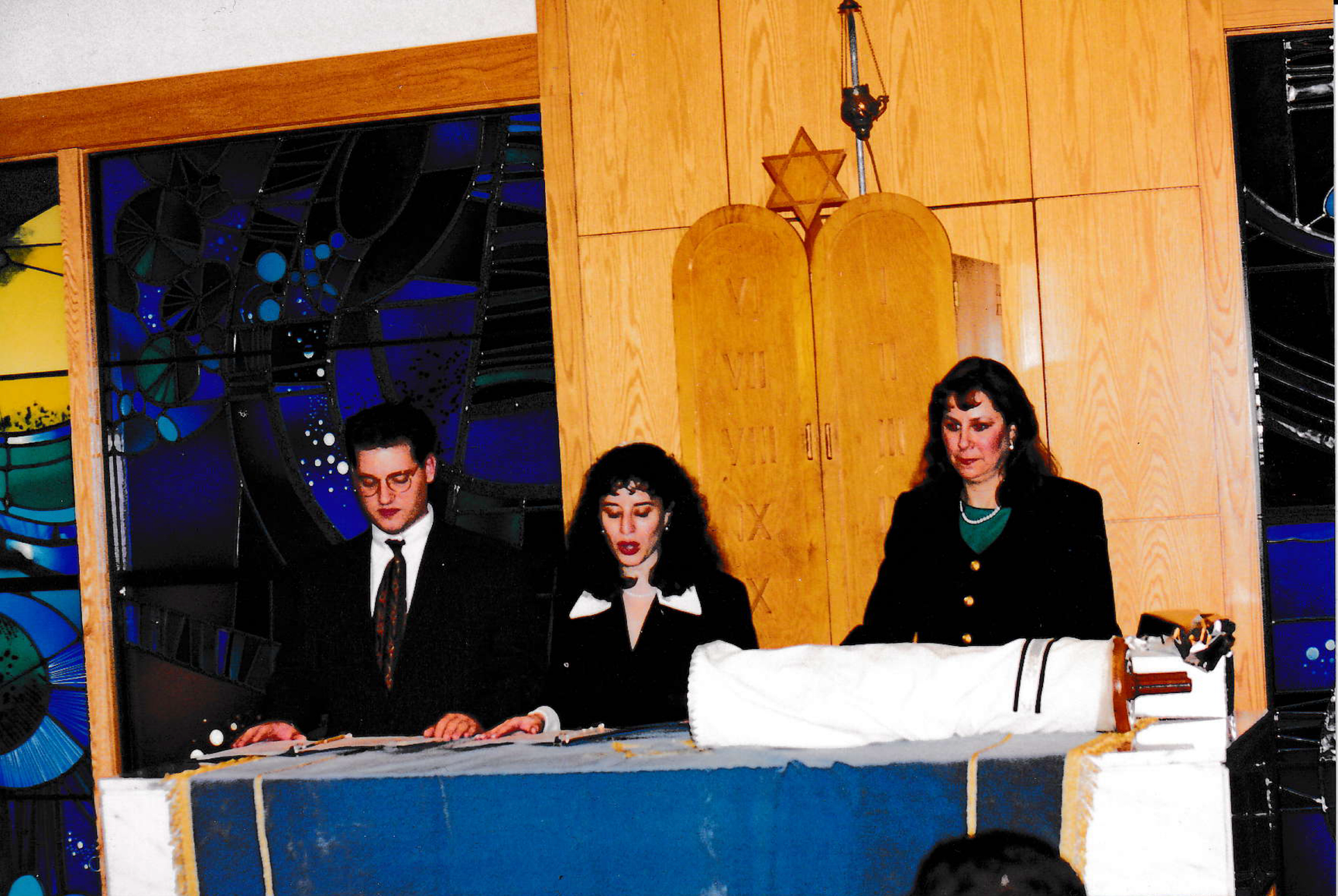
The scroll’s welcome at Temple Sinai in Lawrence, New York: Sue and Herb Cohn; Rhoda and Val Yaverbaum with their daughter Sara; congregation president Barry Mayer; and Temple Sinai clergy.
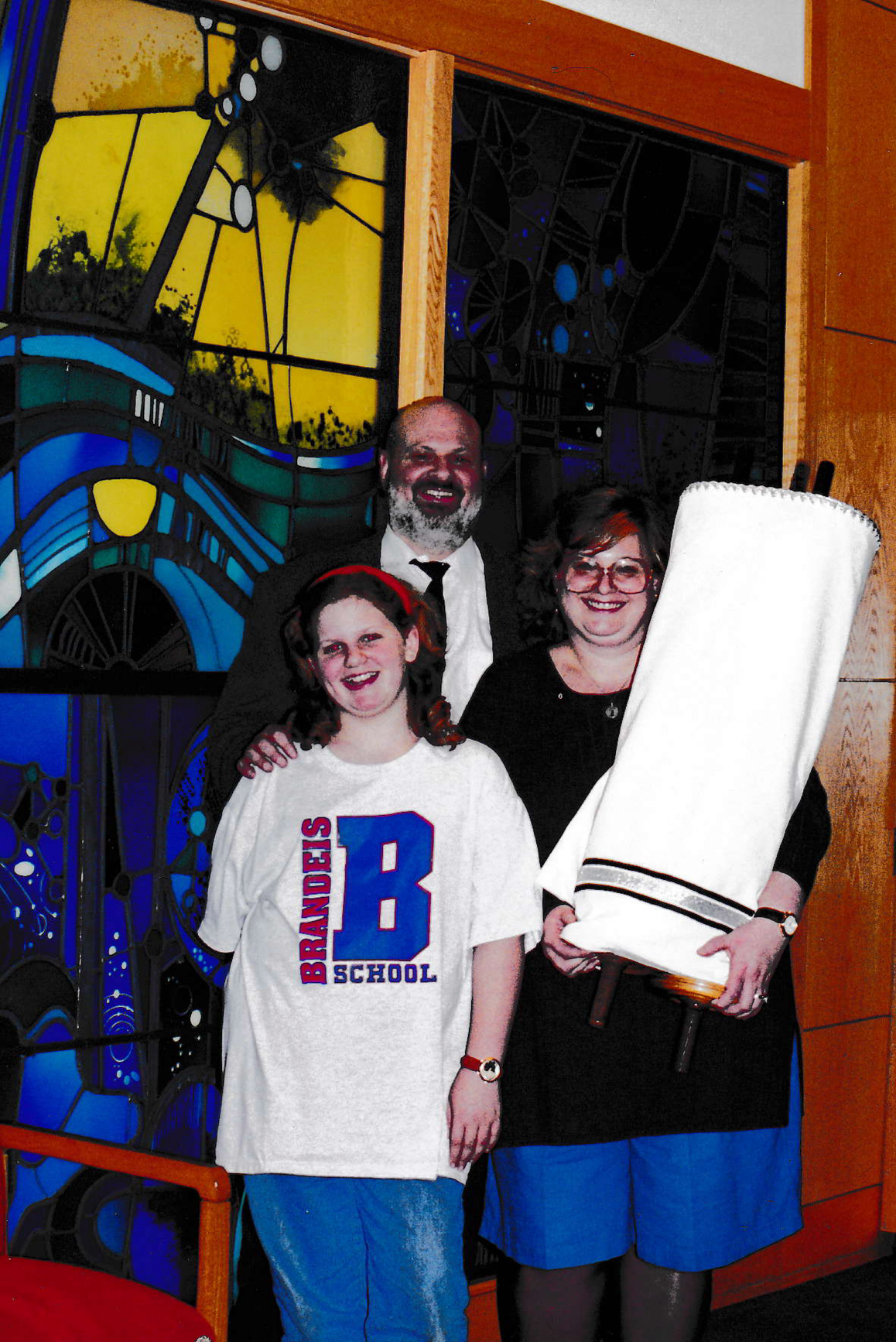
The scroll’s welcome at Temple Sinai in Lawrence, New York: Sue and Herb Cohn; Rhoda and Val Yaverbaum with their daughter Sara; congregation president Barry Mayer; and Temple Sinai clergy.
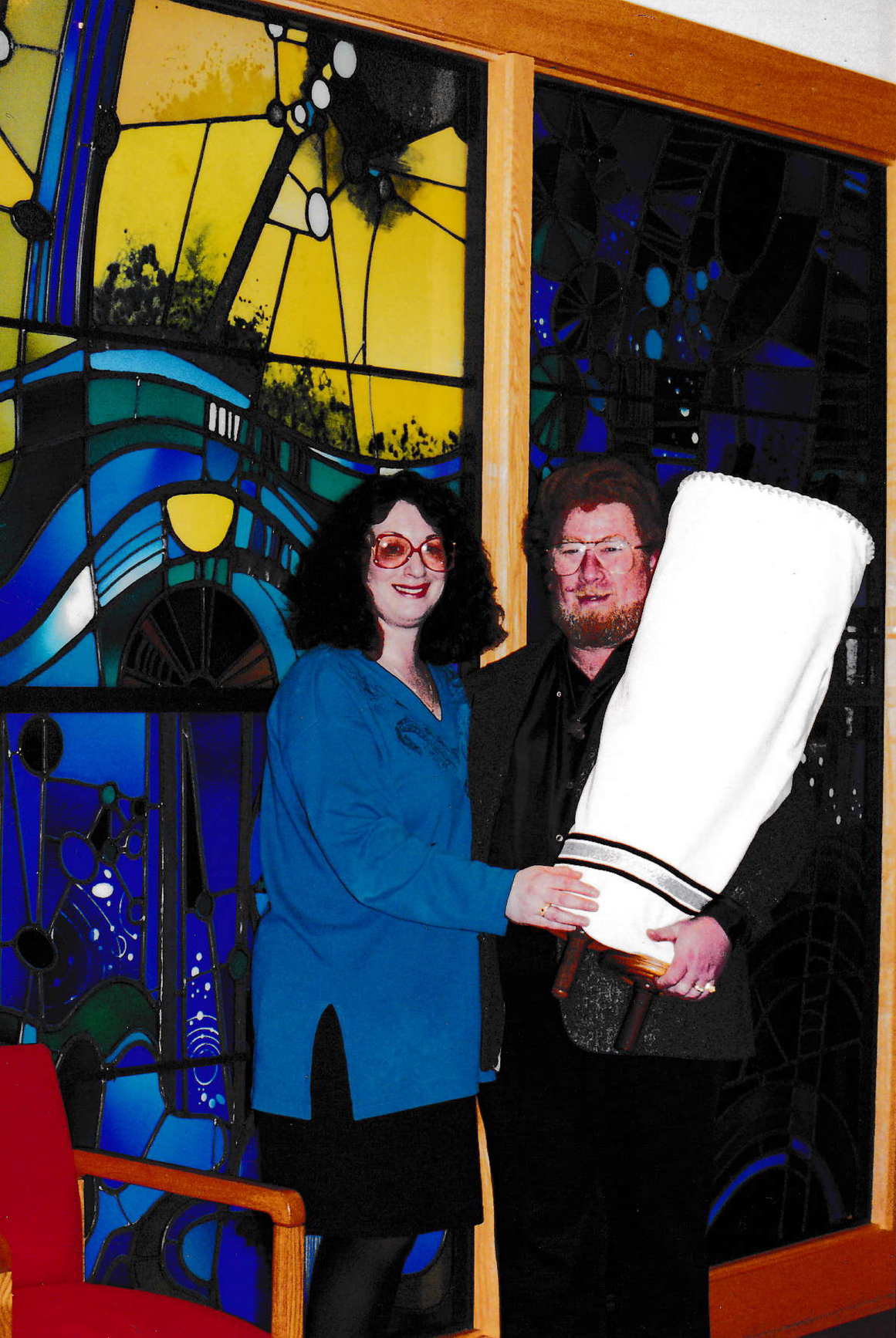
The scroll’s welcome at Temple Sinai in Lawrence, New York: Sue and Herb Cohn; Rhoda and Val Yaverbaum with their daughter Sara; congregation president Barry Mayer; and Temple Sinai clergy.
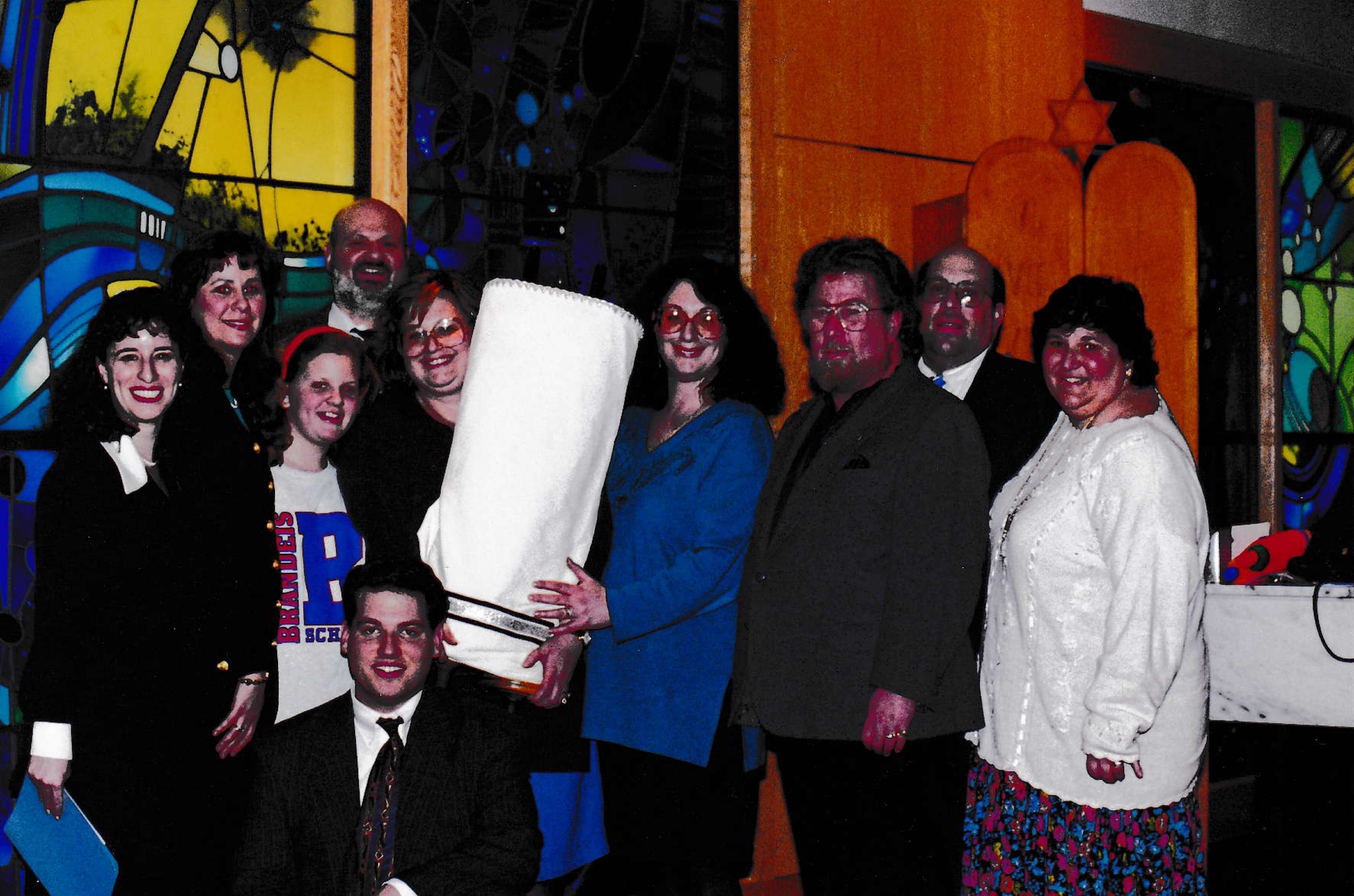
The scroll’s welcome at Temple Sinai in Lawrence, New York: Sue and Herb Cohn; Rhoda and Val Yaverbaum with their daughter Sara; congregation president Barry Mayer; and Temple Sinai clergy.
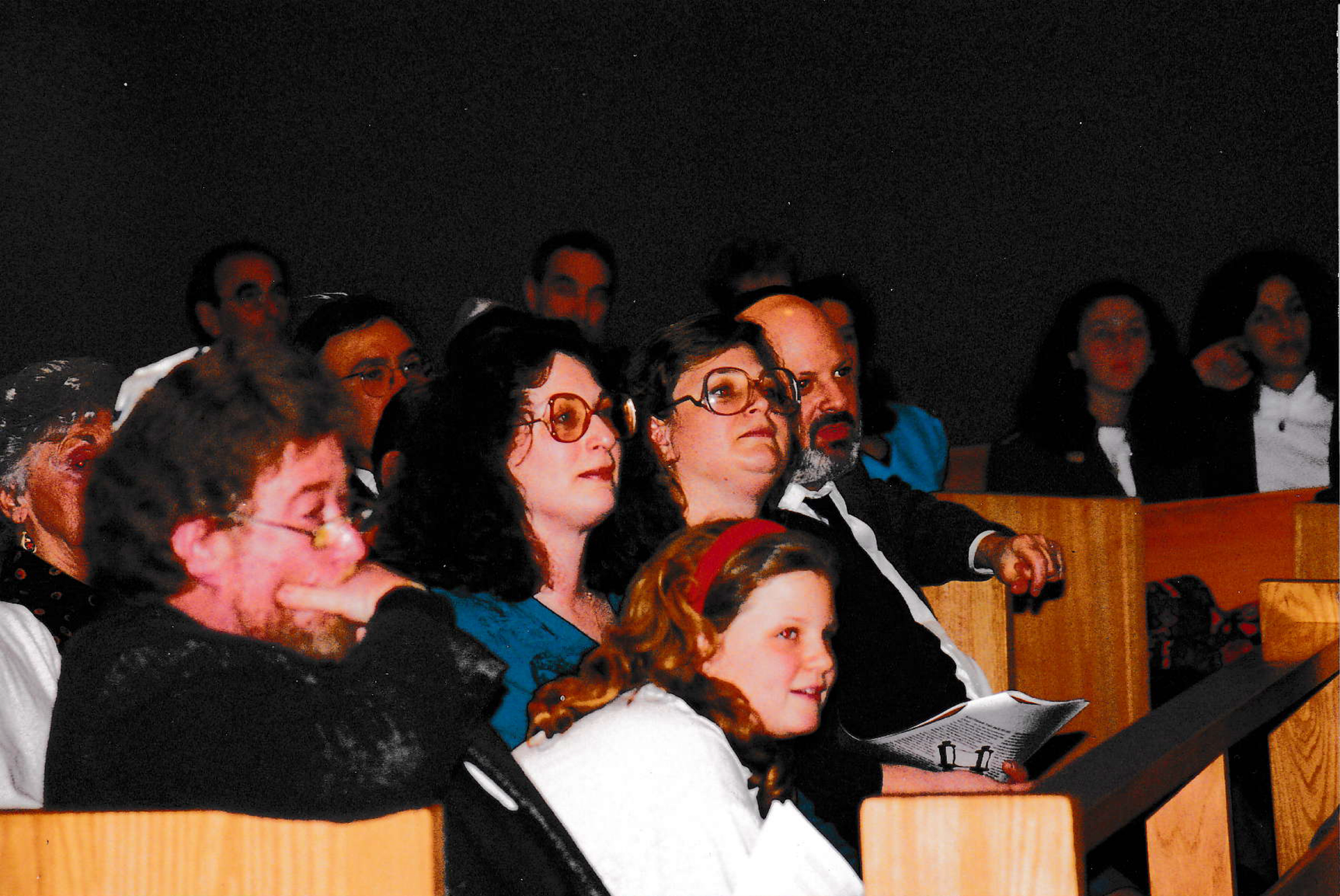
The scroll’s welcome at Temple Sinai in Lawrence, New York: Sue and Herb Cohn; Rhoda and Val Yaverbaum with their daughter Sara; congregation president Barry Mayer; and Temple Sinai clergy.
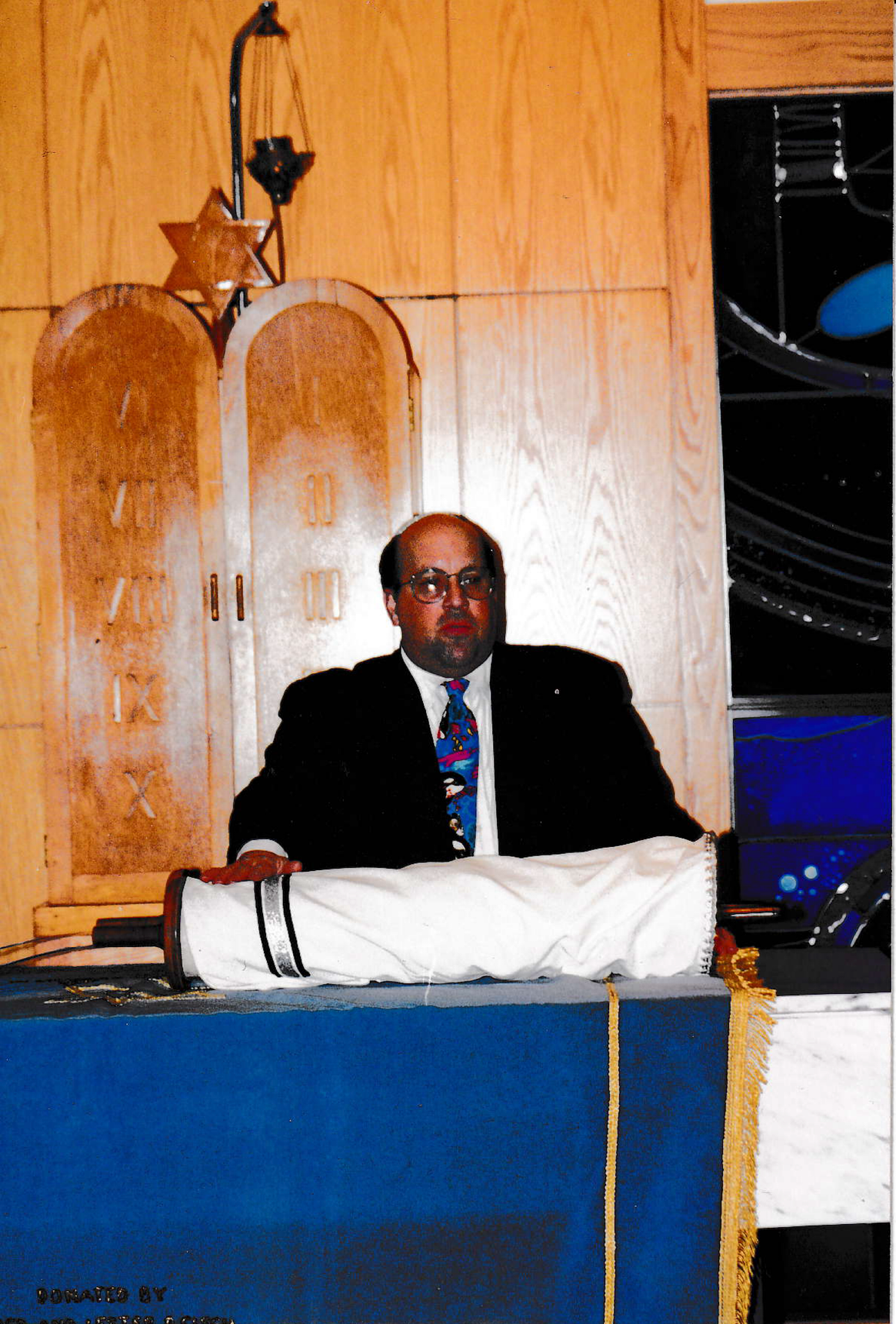
The scroll’s welcome at Temple Sinai in Lawrence, New York: Sue and Herb Cohn; Rhoda and Val Yaverbaum with their daughter Sara; congregation president Barry Mayer; and Temple Sinai clergy.
At Temple Sinai, the scroll was not kept in the Ark. Instead it was housed in a special display built specifically for MST #1408, with a glass front designed to evoke the Holocaust, strewn with bits of broken glass and elements resembling barbed wire. Rabbi Winnig examined the entire scroll and told the congregation it was in great condition, if not entirely kosher, and it was used for many b’nei mitzvah services and holidays; Sue’s niece chanted from it at her bat mitzvah.
In the fall of 2009, the Cohns learned of the planned merger of Temple Sinai with South Shore Reform Congregation Am-Echad of Lynbrook, Long Island, New York, which already held a Holocaust memorial scroll of its own. Under the Trust’s rules at the time, as reported in the Arizona Jewish Post, a congregation can hold only one memorial scroll, so the merger would have sent MST #1408 back to the Trust in London. Sue and Herb, who had relocated to Tucson in 2006 and become members of Congregation Or Chadash, moved fast: working with the Or Chadash Board of Directors, they arranged for MST #1408 to come to Tucson instead. The formal hand-over receipt, signed on December 4, 2009, designated Herb to “receive, caretake and transport” the scroll on Or Chadash’s behalf. The receipt also noted, presciently, that the condition of the historical scroll was “not guaranteed to be kosher.”
Getting the scroll home to Tucson was its own small adventure. The Cohns flew east to retrieve it and carried it through Newark Airport in a five-foot duffel bag, drawing startled looks from fellow travelers. “People thought we were carrying a dead body,” Sue Cohn later recalled. At the Newark Airport security checkpoint, a guard wanted the Torah removed from its bag and unrolled for inspection. A supervisor, in Sue Cohn’s words, had the sechel (wisdom) to simply let it pass through the scanner instead.
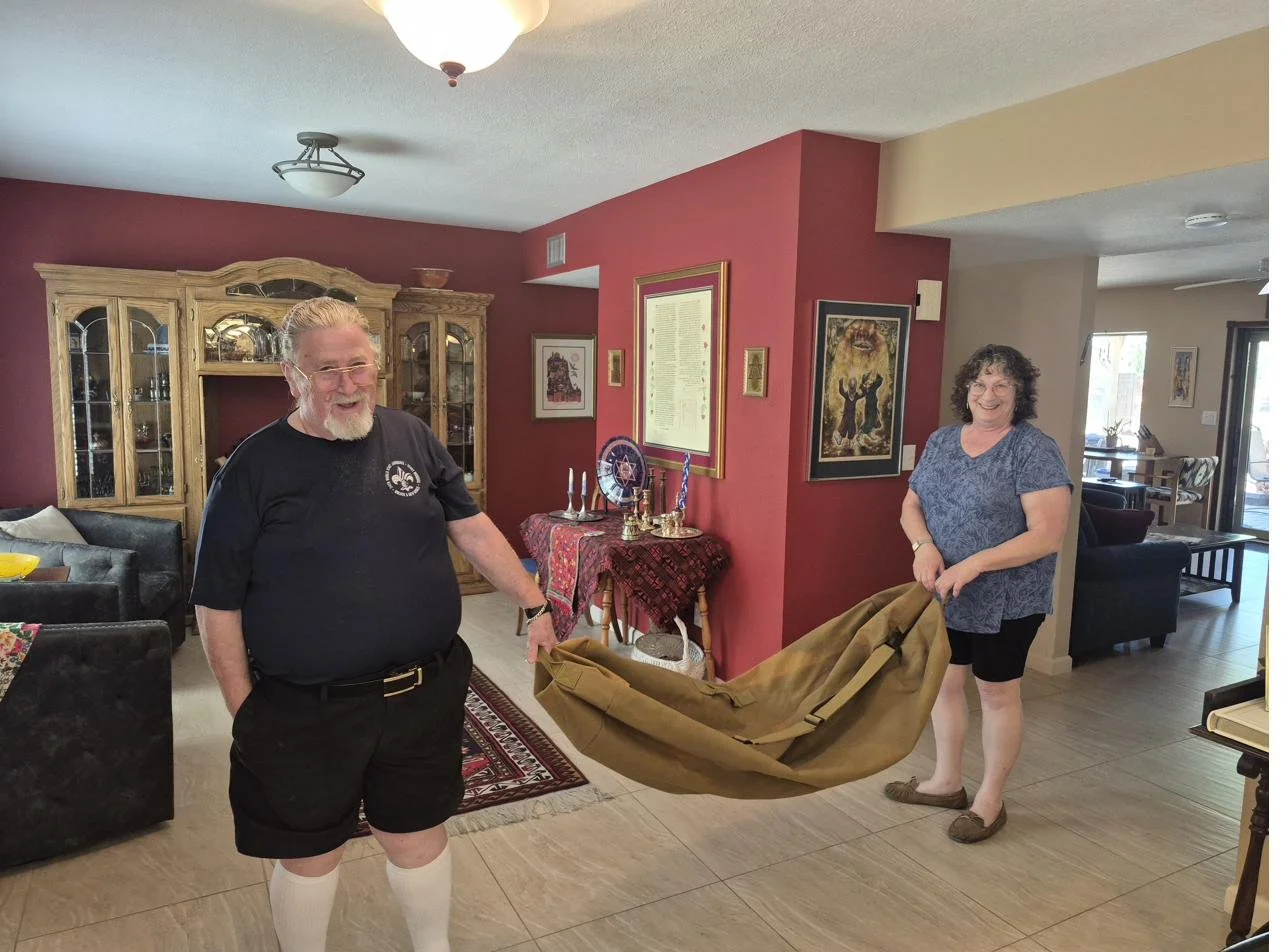
Seventeen years later, the same hands. Sue and Herb Cohn in July 2026 with the duffel bag in which MST #1408 traveled from New Jersey to Tucson in 2009.
The scroll was too large for an overhead bin and too precious to entrust to checked luggage, so the Cohns purchased it its own airplane seat, for $600, and flew it home between the two of them.
Congregation Or Chadash, which was then meeting at Handmaker, a Tucson retirement and nursing care facility, formally received the scroll on December 7, 2009. With its arrival, Rabbi Thomas Louchheim told the Arizona Jewish Post, a once vital Czech Jewish community “was brought back to life.”
Because Or Chadash had no confirmation class that year, the congregation chose to celebrate its new scroll with a wedding. On Tuesday, May 18, the evening before Shavuot, Rabbi Louchheim led a “Dinner and Discussion” evening at a local restaurant, offering a teaching titled “Relevant Revelation Today.” The next morning the congregation observed Shavuot with a festival and Yizkor service in its chapel. Then, on Friday, May 21, 2010 — 8 Sivan 5770, at the culmination of Torah Celebration Week in the season of Shavuot, Z’man Matan Torah, “the time of the giving of the Torah” — Or Chadash celebrated the official marriage of MST #1408 to the congregation at its Kabbalat Shabbat service at Handmaker. Rabbi Louchheim read a ketubah (marriage contract) naming the scroll, “a Czech Memorial scroll from an unknown village,” as the bride, and the membership of Congregation Or Chadash as the groom. In it, the congregation pledged to treasure the scroll “with honor and devotion” and to house it in the holiest spot in the synagogue, the Aron Kodesh (Holy Ark). “Having this scroll,” Louchheim said, “becomes a metaphor for our survival.” Days later, the rabbi wrote to the Cohns that the evening’s feeling and sense of connection could only be attributed to their inspiration and efforts in bringing the Torah to Tucson.
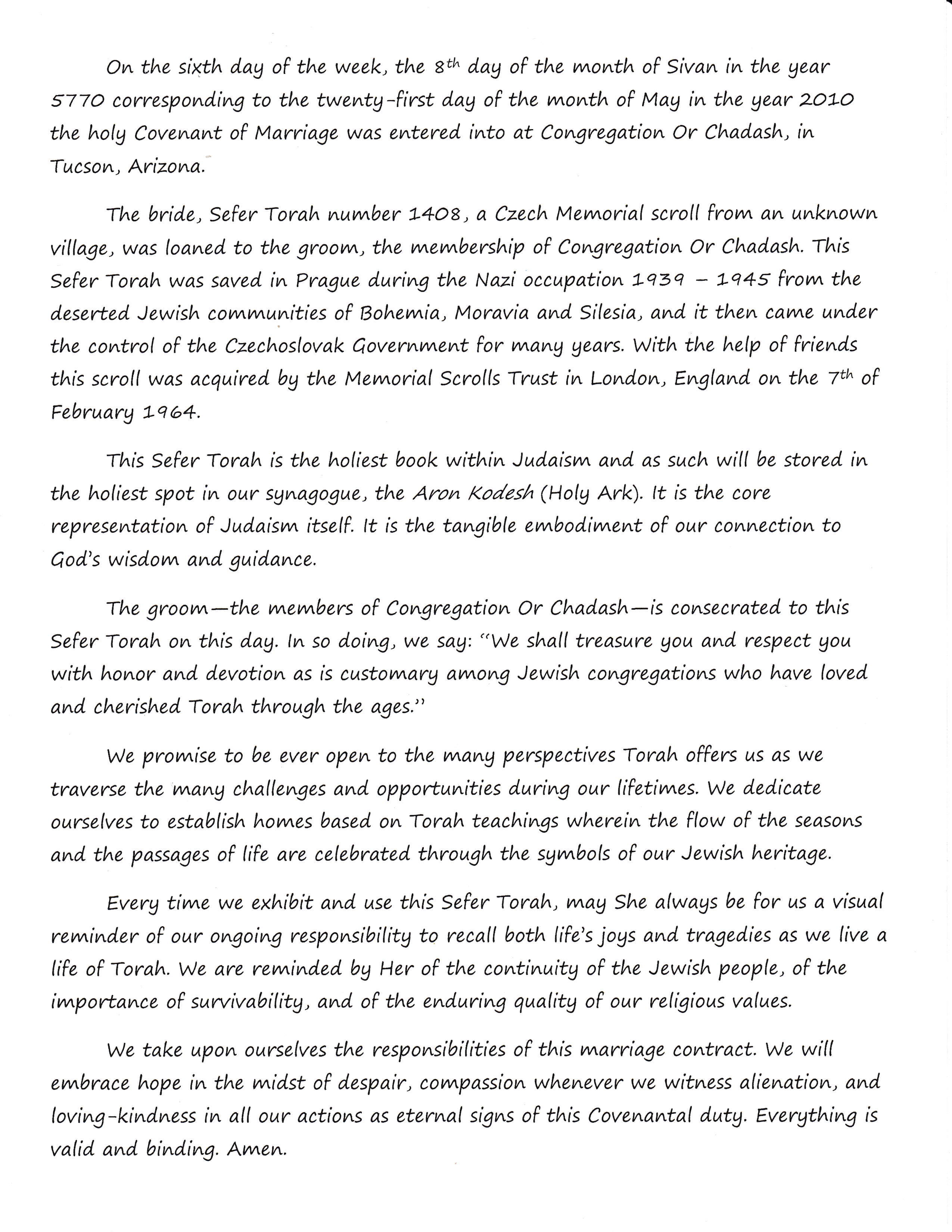
The ketubah read by Rabbi Thomas Louchheim at the May 21, 2010 “wedding” of MST #1408 to Congregation Or Chadash.
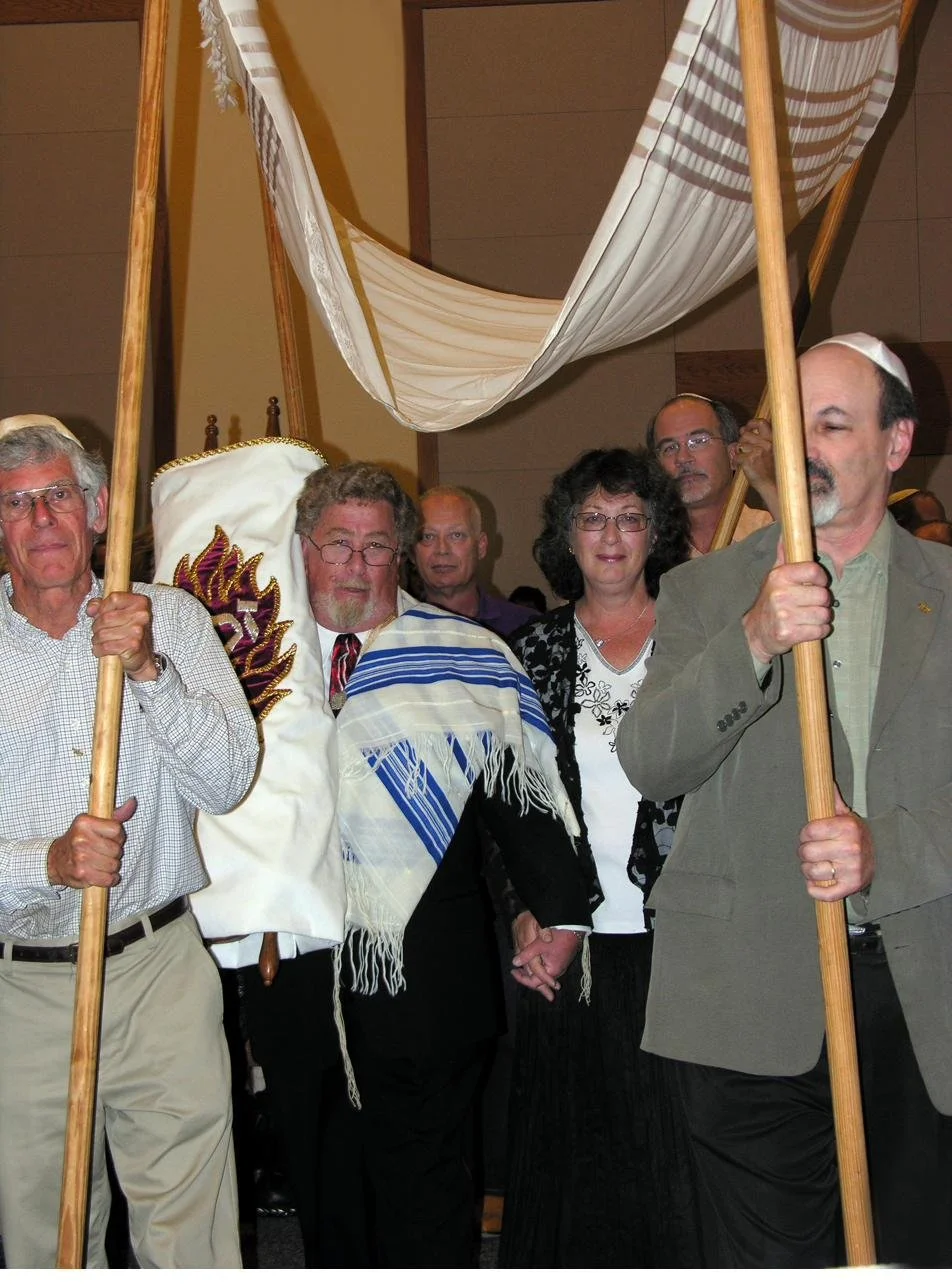
The May 21, 2010 wedding ceremony at Handmaker, with the scroll carried in procession under a chuppah.
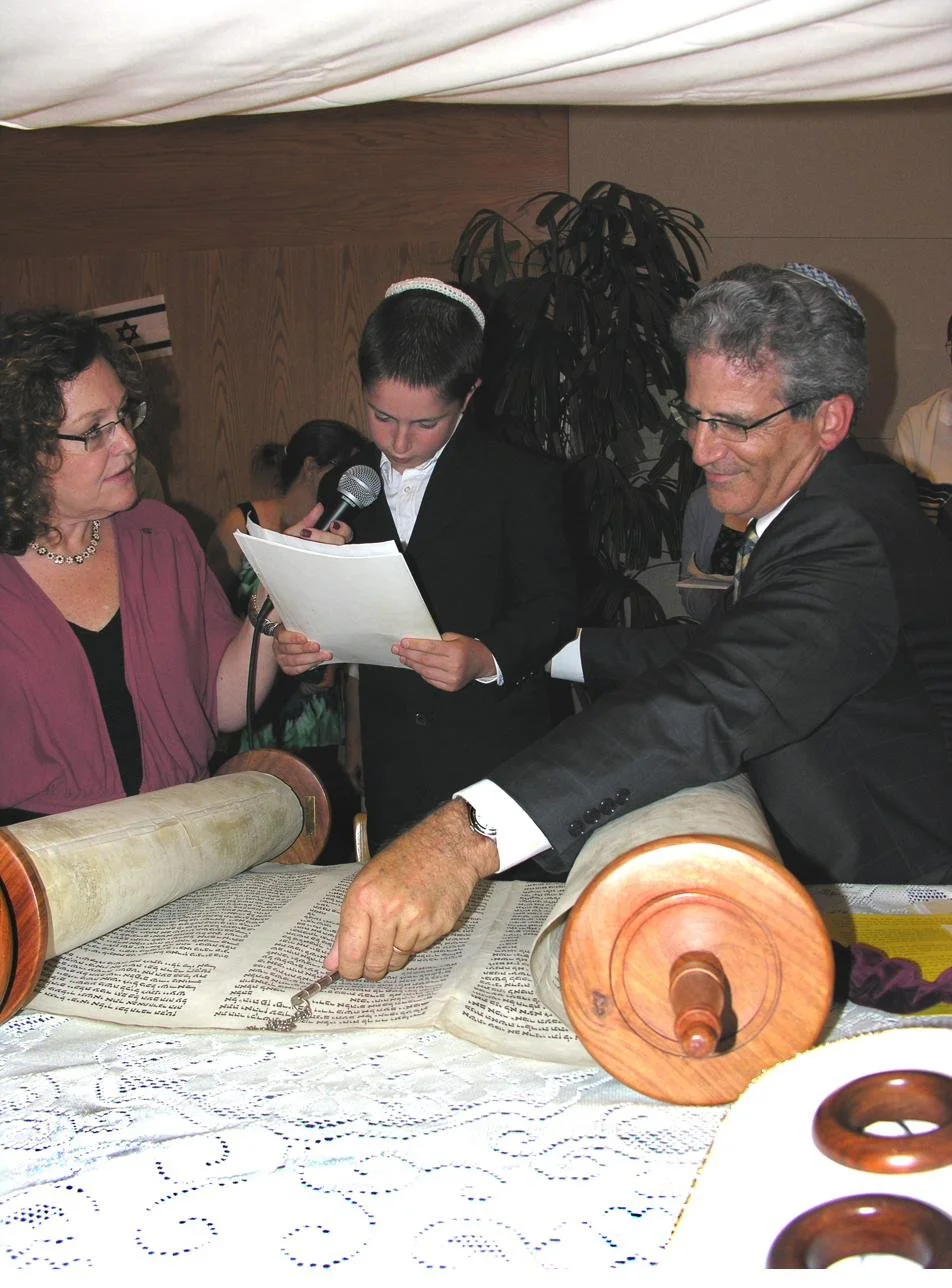
The May 21, 2010 wedding ceremony at Handmaker, with the scroll carried in procession under a chuppah.
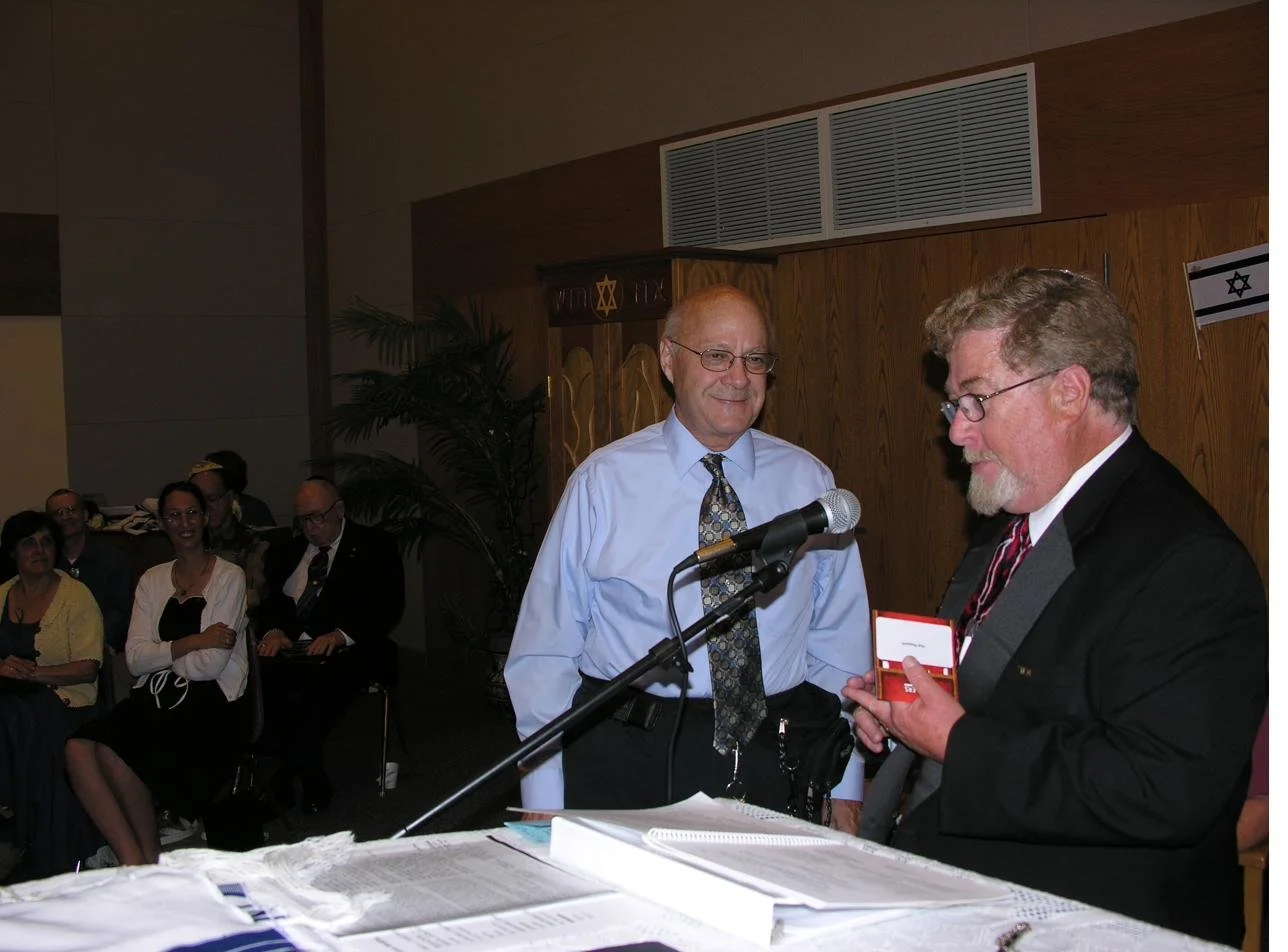
The May 21, 2010 wedding ceremony at Handmaker, with the scroll carried in procession under a chuppah.
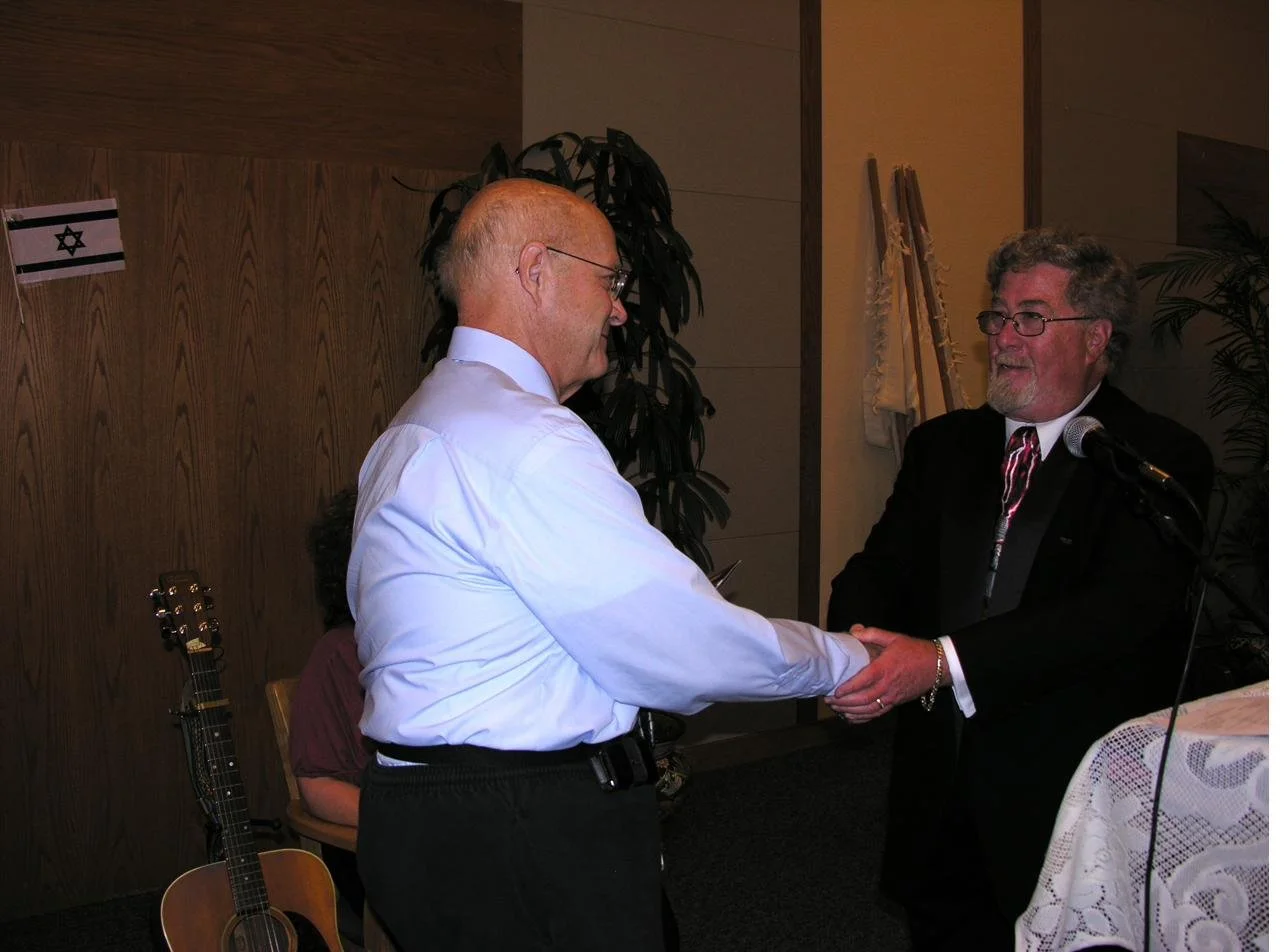
The May 21, 2010 wedding ceremony at Handmaker, with the scroll carried in procession under a chuppah.
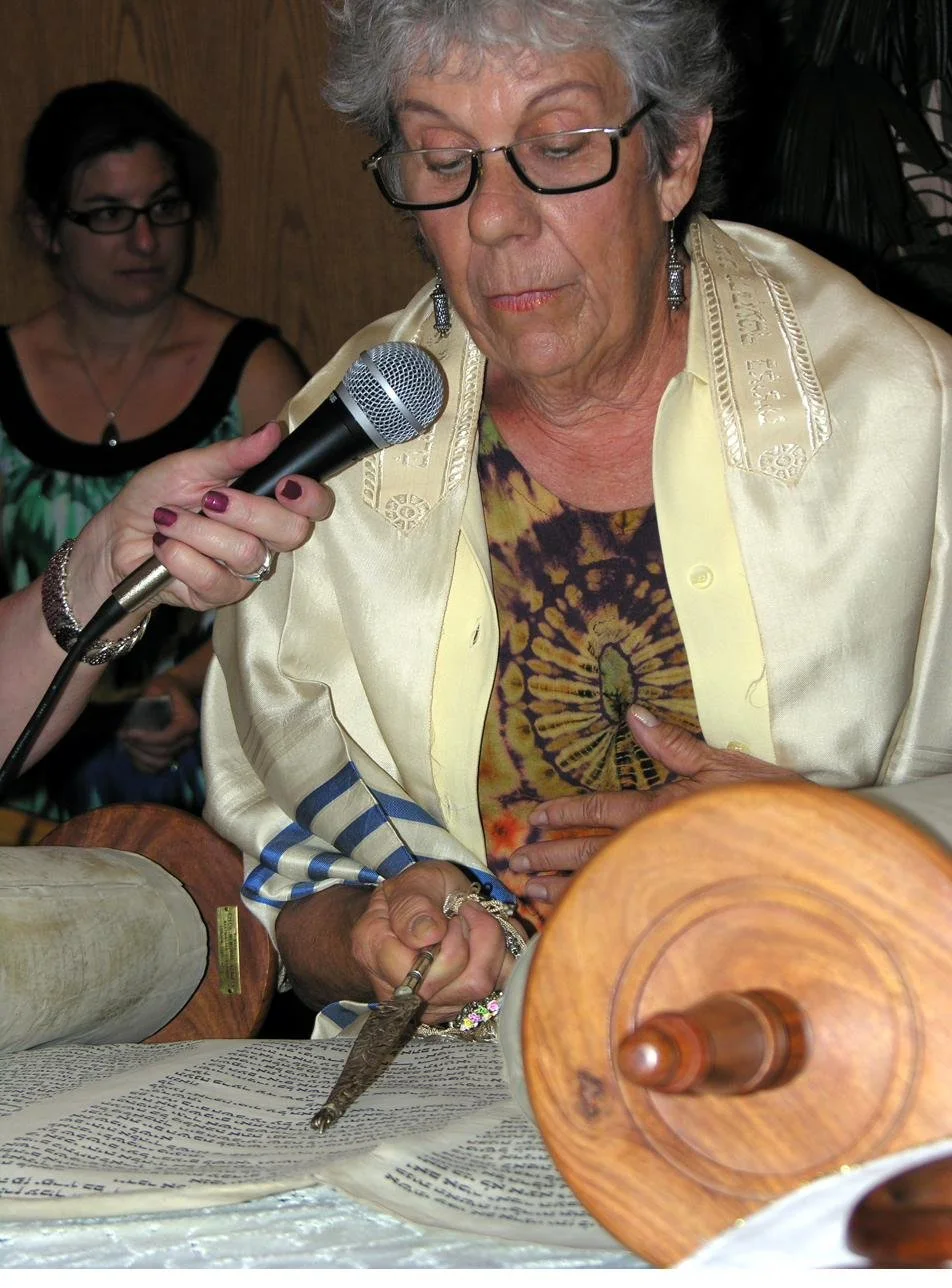
The May 21, 2010 wedding ceremony at Handmaker, with the scroll carried in procession under a chuppah.
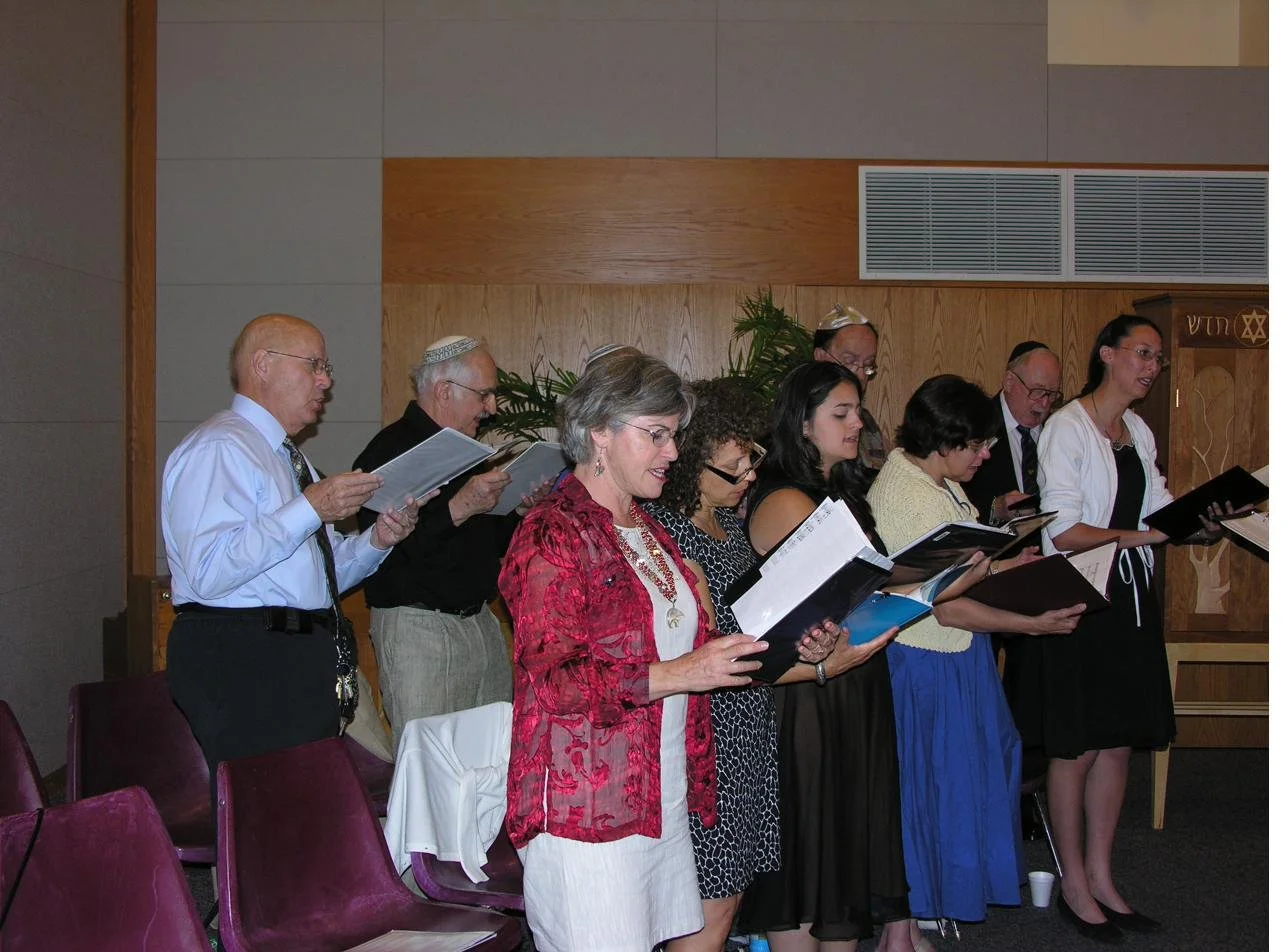
The May 21, 2010 wedding ceremony at Handmaker, with the scroll carried in procession under a chuppah.
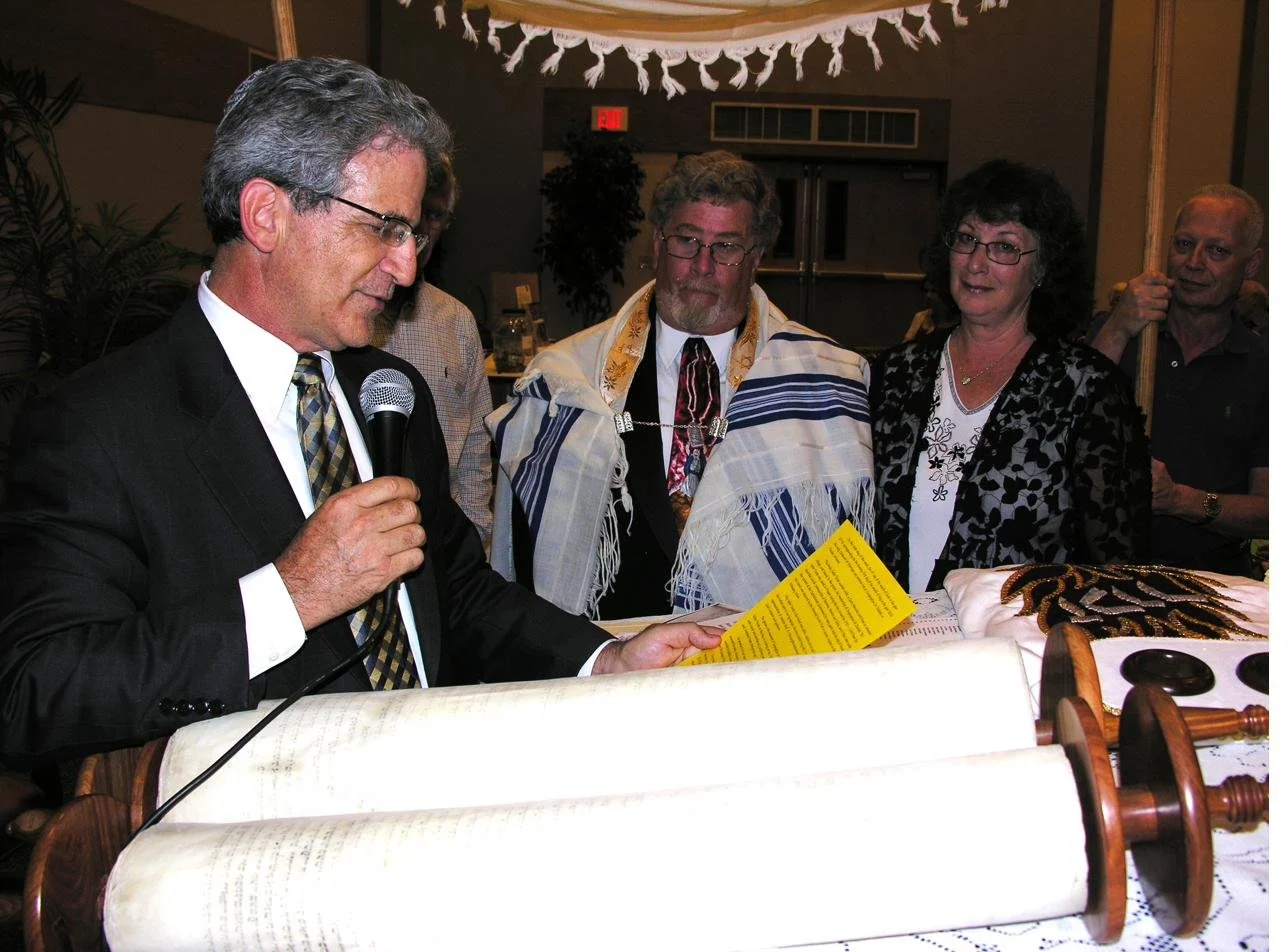
The May 21, 2010 wedding ceremony at Handmaker, with the scroll carried in procession under a chuppah.
Fittingly, Herb Cohn was the first person to chant from the scroll in Tucson, reading from it when his birthday parsha came around in December, and he has done so again at Kol Ami, both times in honor of the scroll and the anniversary of his own bar mitzvah. At Or Chadash, the scroll was carried through the congregation during the hakafah processions of the High Holy Days and brought out for Kol Nidre. It was also chanted from on Sukkot and Simchat Torah, and it was used regularly for b’nei mitzvah.
Soon after the scroll arrived at Or Chadash in Tucson, the Cohns reached out to the Jewish Museum in Prague and requested lists of Holocaust victims, in order to link the scroll to the Shoah. In December 2009, the museum’s Holocaust archive sent Herb records of Jewish boys deported to Terezín at around the age of bar mitzvah. Among them was Rudolf Kohner, son of Vilém and Anna Kohner, born June 4, 1929, who was deported from Kolín to Terezín one day after his thirteenth birthday and perished after being sent on to Trawniki. Two other boys who were not yet thirteen, Jiří Holzer and Jan Schuk, followed the same route and did not survive. Those lists became part of Or Chadash’s testament to the memory of the Shoah and its way of connecting the scroll to people.
In 2021, Congregation Or Chadash and Temple Emanu-El, whose members had already begun worshipping and working together, completed their official merger to form Kol Ami Synagogue. The paperwork to formally transfer stewardship of MST #1408 to the new congregation took additional time to complete.
Through all of those years, in New York and at Or Chadash, MST #1408 had no “city of origin” and no adopted town; the choice of a symbolic home came at Kol Ami. The Memorial Scrolls Trust had no information about the scroll’s provenance, but it gave the congregation permission to examine its list of Czech towns with documented Jewish communities that had no scroll yet linked to them. After research, Kol Ami’s Sacred Living Committee identified Cheb, a town that had once been a celebrated center of Jewish learning, home in the Middle Ages to the renowned Talmudic scholar Rabbi Nathan. The Trust confirmed the prior existence of a Jewish community in Cheb, though it could not confirm a direct link to this specific scroll, and granted the congregation permission to adopt the town as the scroll’s symbolic home. Through a friend who had worked with the Trust for many years, the congregation also made contact with a researcher who had once lived in Cheb and written a book, in Czech, on the town’s Jewish history.
On April 2, 2022 (2 Nisan 5782), the scroll was rededicated and sanctified as part of Kol Ami’s “Kulanu B’Yachad” service, the celebratory “wedding” of the two legacy congregations into one community. For the second time in its Tucson life, the scroll stood at the heart of a wedding. This time the scroll was a witness rather than the bride. Rabbi Scott Saulson introduced the scroll with the same verse from Lamentations that closes the memorial plaque at the site of the destroyed synagogue in Cheb: “Restore us, Adonai, to You, and we will be restored; renew our days as of old” (5:21). The scroll was then carried into the sanctuary under a chuppah by Seth Ruskin, Kol Ami’s first president, and escorted by members of the congregation’s b’nei mitzvah class. A Kol Ami Dedication Document, modeled on a ketubah by the congregation’s Transition Ritual Taskforce, was signed by the founding clergy — Rabbi Thomas Louchheim, Rabbi Scott Saulson, Cantor Janece Cohen, and Cantorial Soloist Marjorie Hochberg — along with Elaine Jones and Seth Ruskin, the last presidents of Congregation Or Chadash and Temple Emanu-El. Norma Cohen recounted the scroll’s history, including the Trust’s approval of both the transfer to Kol Ami and the designation of Cheb as the scroll’s home, then awaiting only the completion of trans-Atlantic paperwork. The congregation declared together: “In the name of Kol Ami, we accept this Sefer Torah as a sacred possession of our synagogue in fulfillment of our obligations to the Jewish people.” The scroll was then placed in the Ark beside the scrolls of the two legacy congregations.
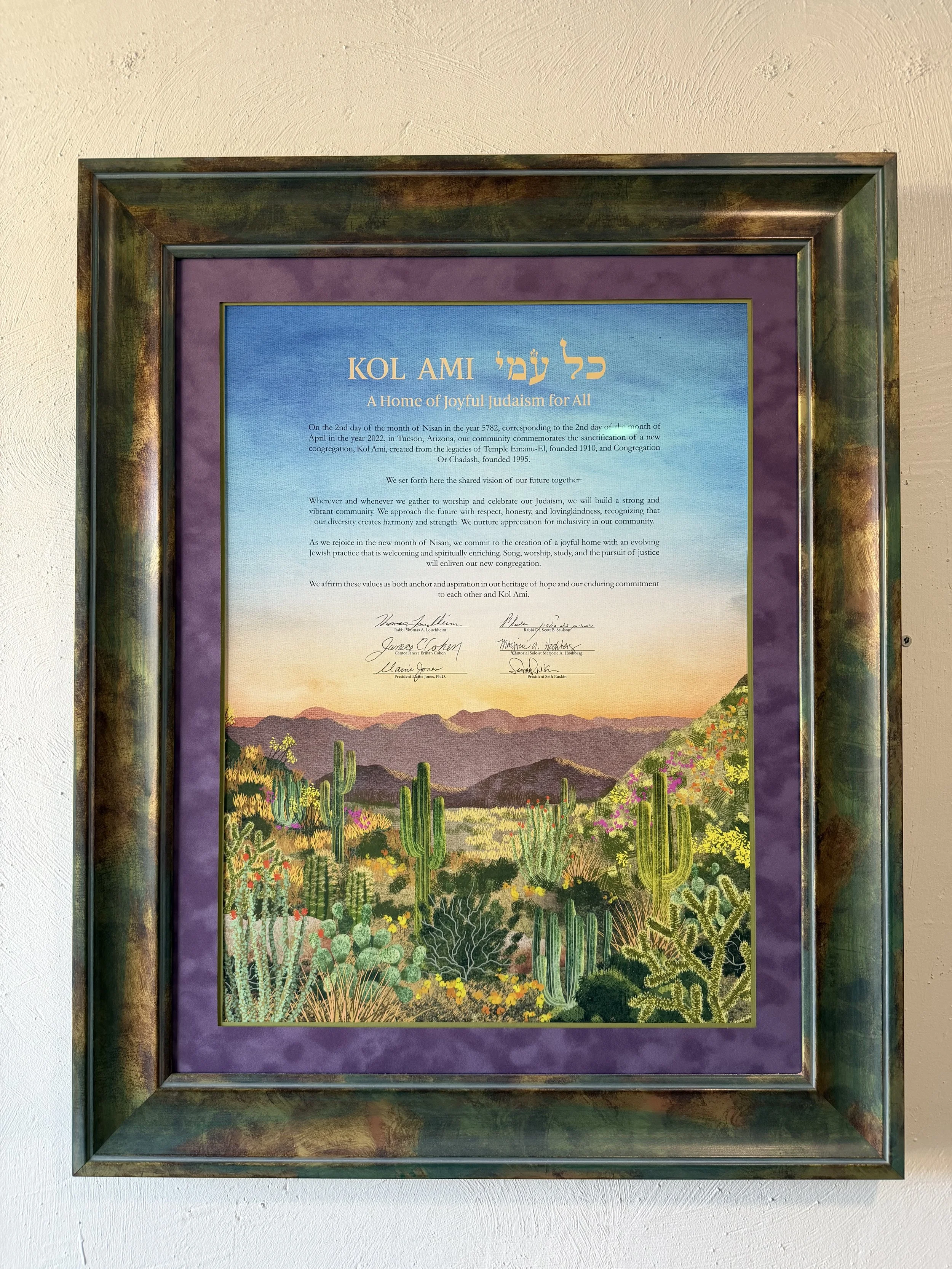
The Kol Ami Dedication Document, modeled on a ketubah and signed at the Kulanu B’Yachad service, April 2, 2022.
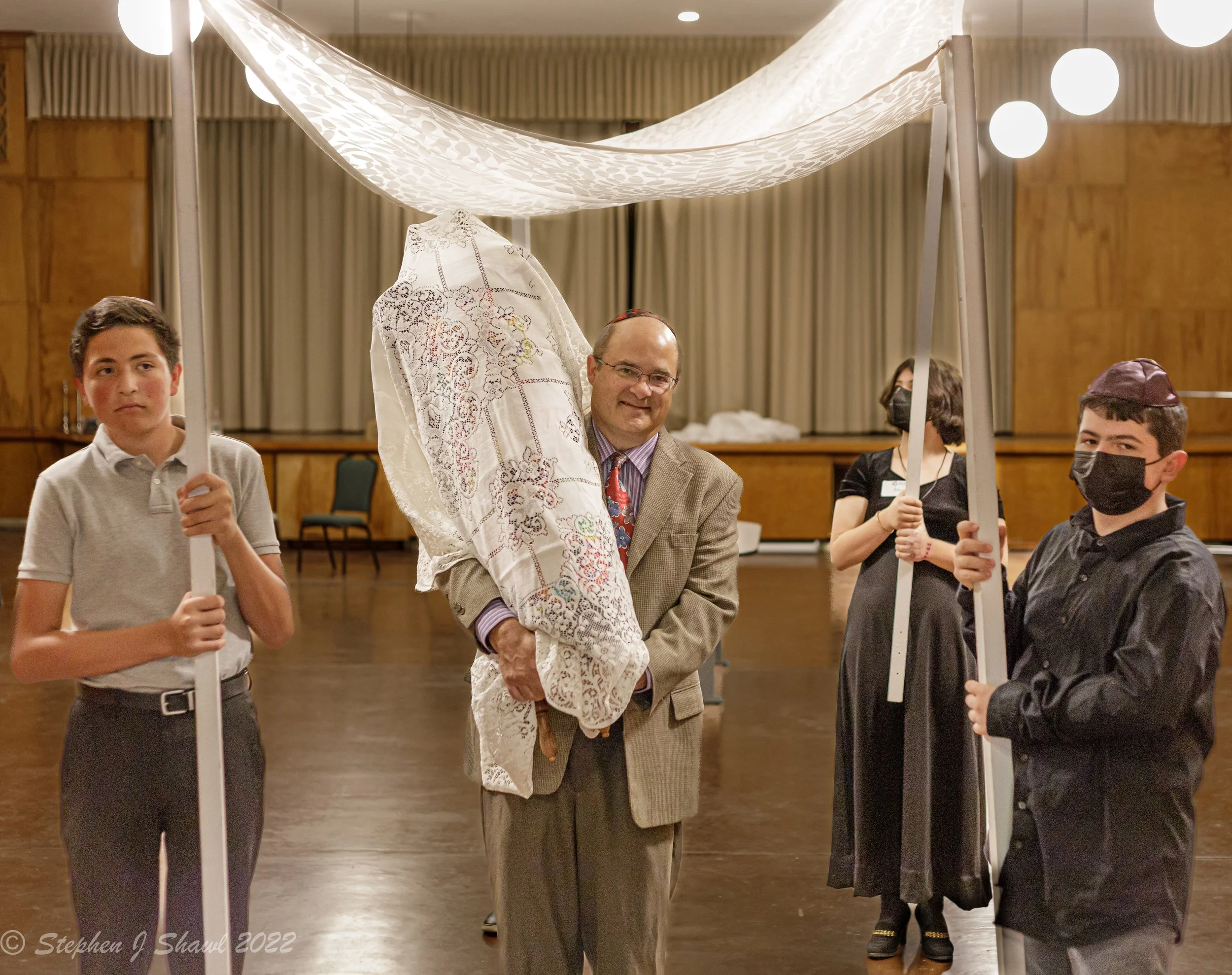
Seth Ruskin, first President of Kol Ami Synagogue, holds the scroll under a chuppah carried by Kol Ami's first b'nei mitzvah students.
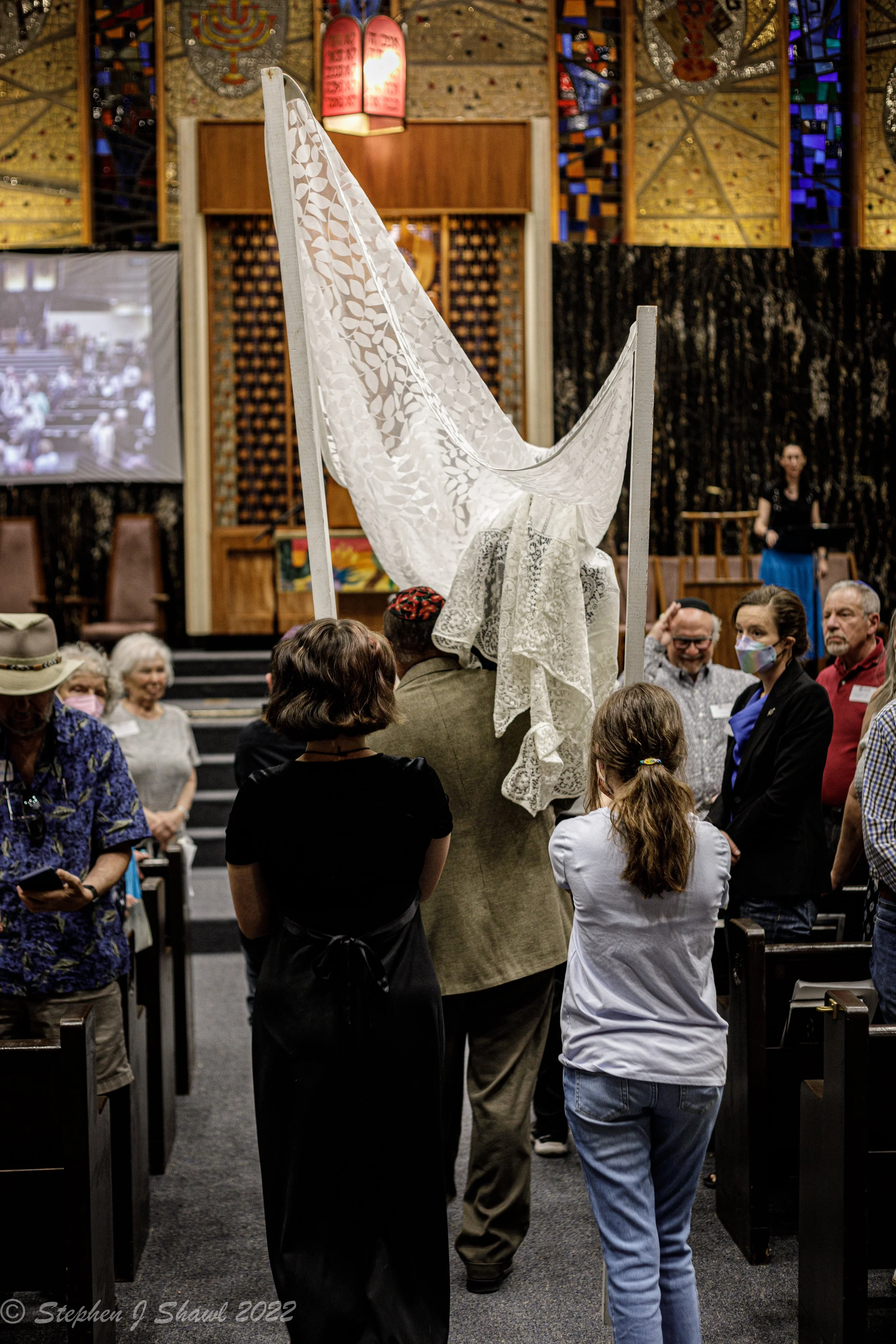
Kulanu B’Yachad service, April 2, 2022
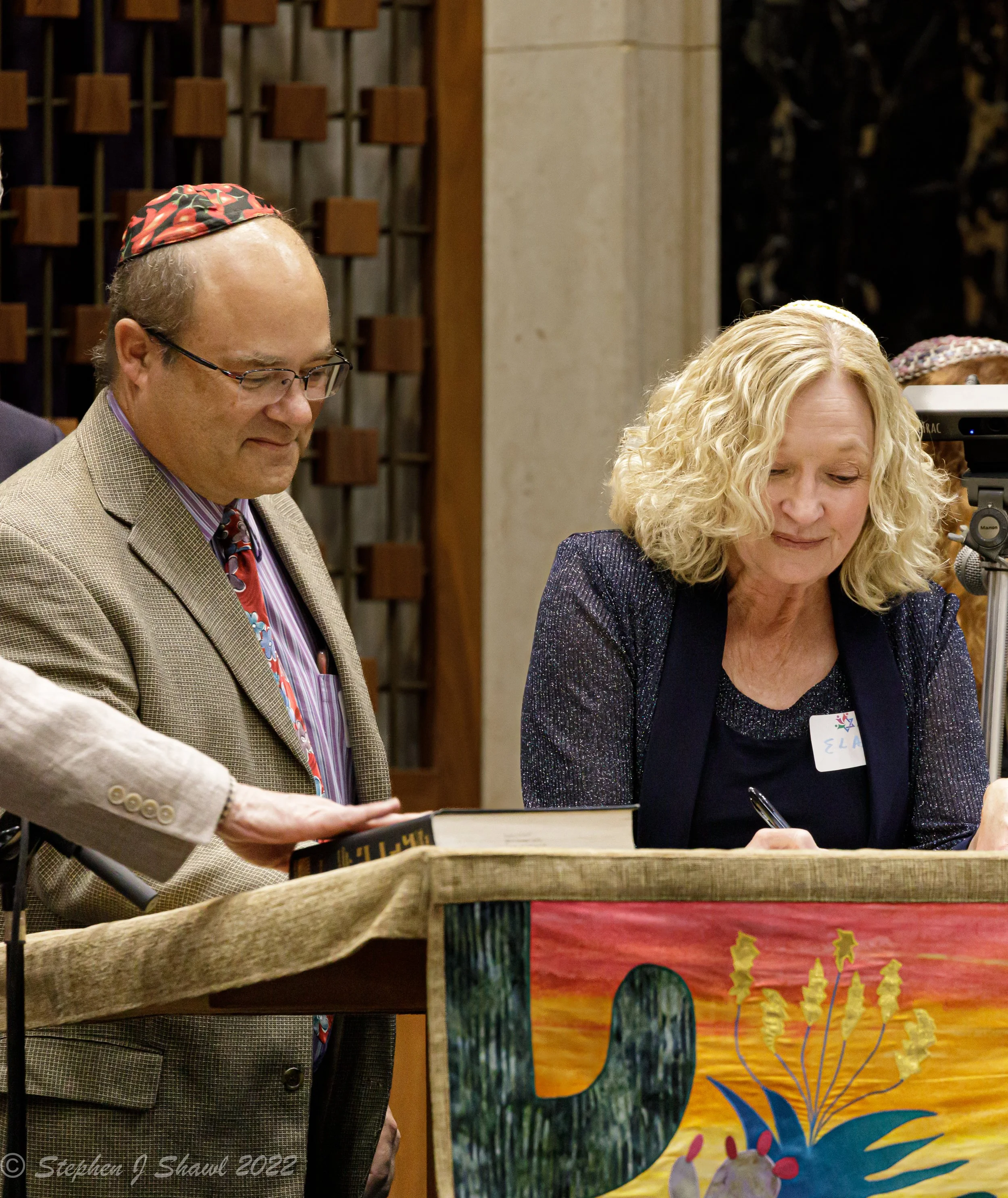
Elaine Jones, last president of Congregation Or Chadash, and Seth Ruskin, last president of Temple Emanu-El, sign the ketubah alongside Kol Ami's first clergy.
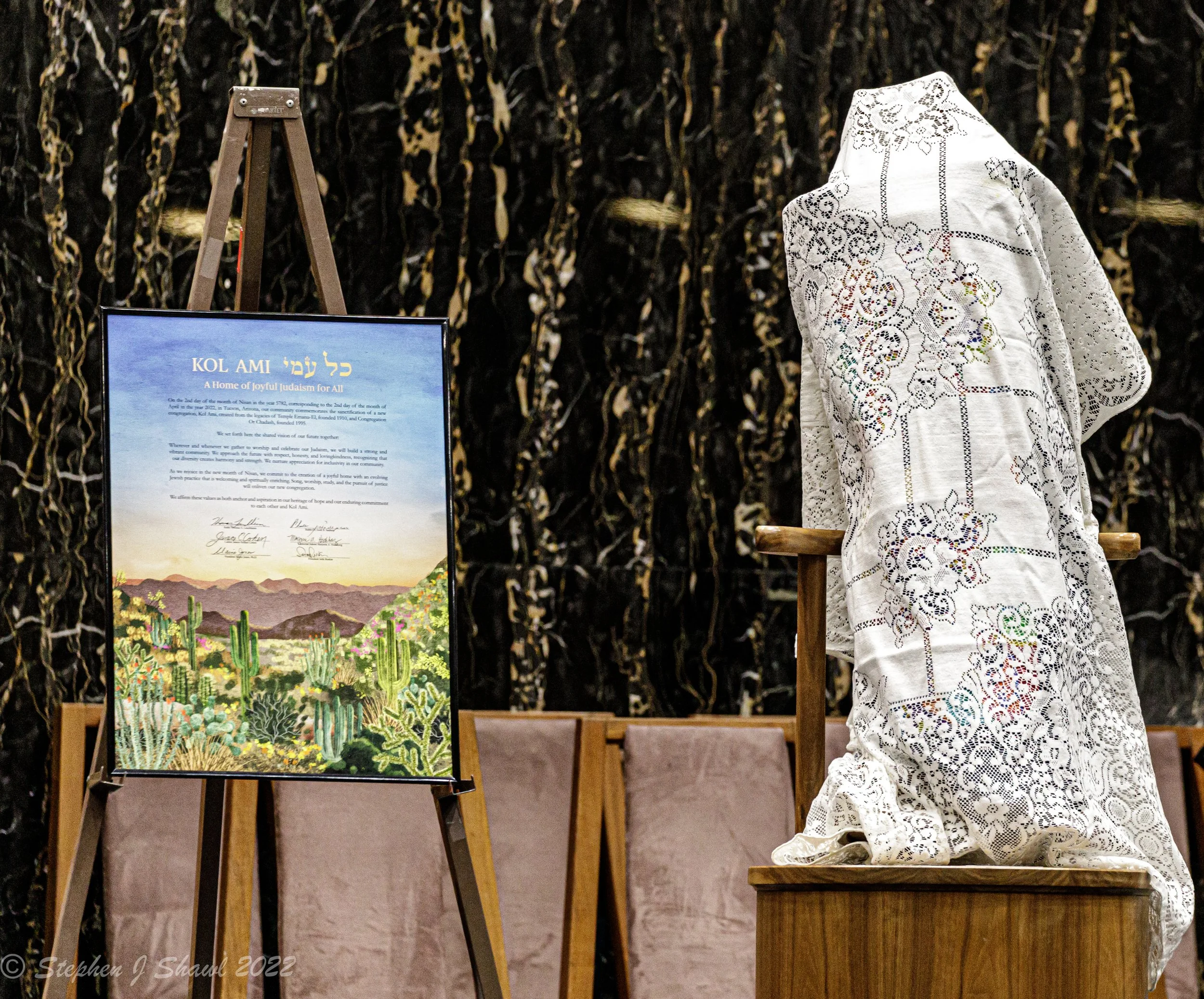
The signed dedication document sits next to the scroll in front of the congregation at Kulanu B'Yachad.
A new, brightly colored mantle was commissioned for the scroll especially for the occasion, created to celebrate the formation of Kol Ami and the continuity of Jewish life it represented. Margery Langner assisted in developing the design and created the mantle herself. Unveiled by Emily Joseph during the service, it surrounds the scroll with words from Kol Ami’s mission statement — tikvah (“hope”), tzedek (“justice”), and simcha (“joy”) — along with “remember” and a golden flame attesting to the scroll’s history as a Holocaust survivor. The scroll continues to wear the same mantle today.
The scroll also has a second mantle for use during the High Holy Days, made specifically for it when it arrived at Or Chadash. The Cohns commissioned the High Holy Days mantle for the scroll, the zachor (“remember”) mantle, which Herb designed himself by combining two traditional designs. It is still used for the High Holy Days at Kol Ami.
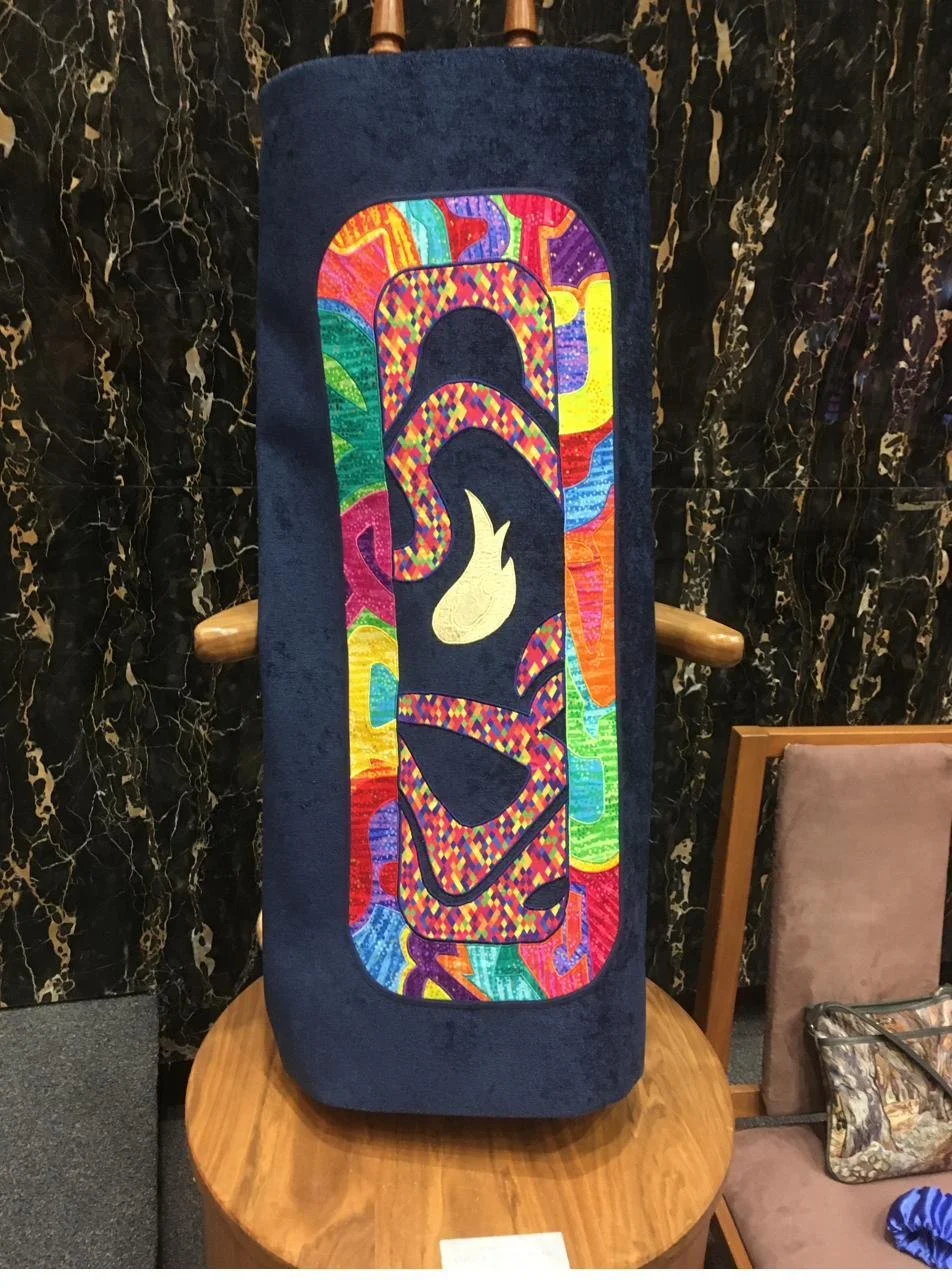
The everyday mantle, created by Margery Langner for the 2022 Kulanu B’Yachad service.
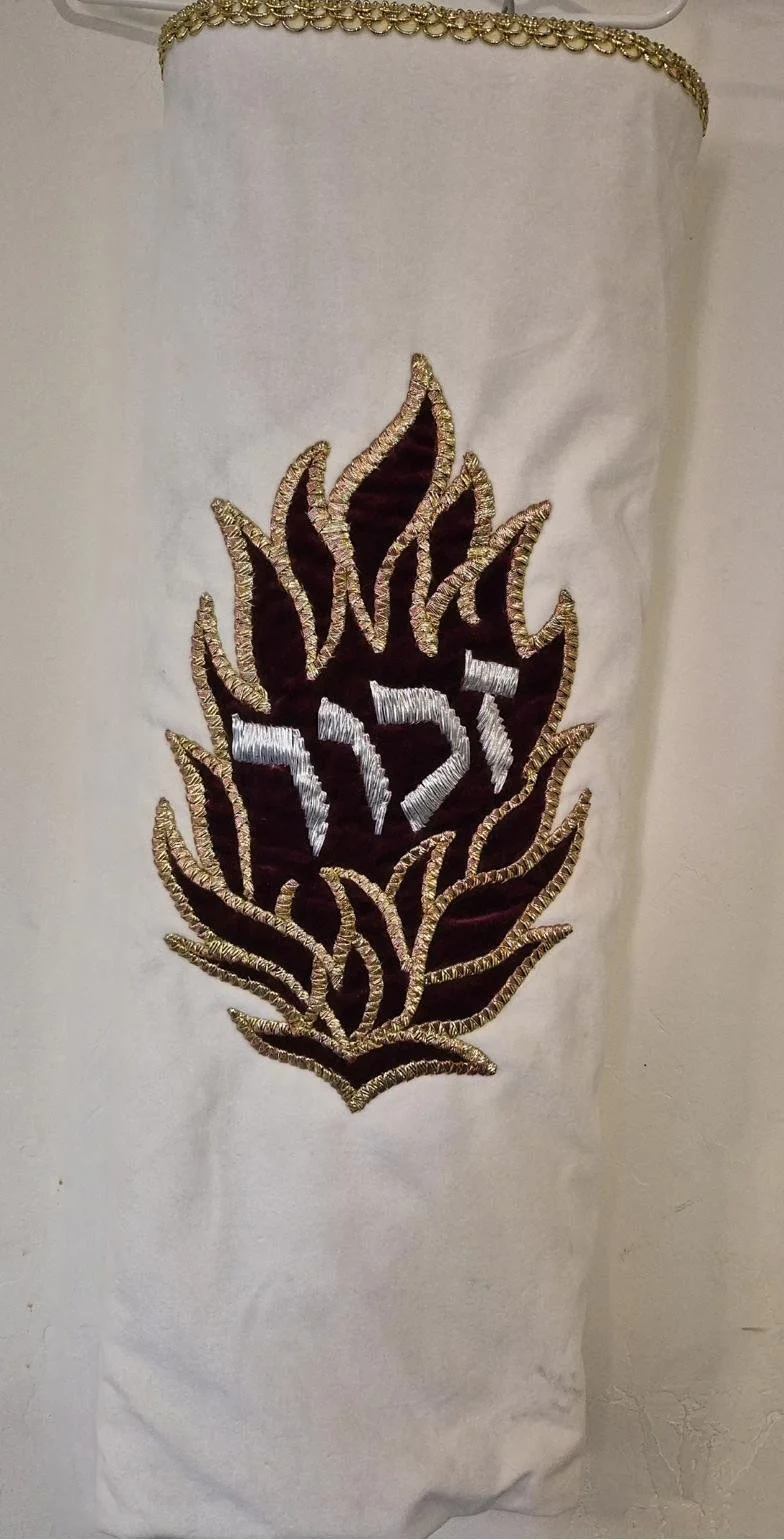
The zachor (“remember”) High Holy Days mantle, designed by Herb Cohn.
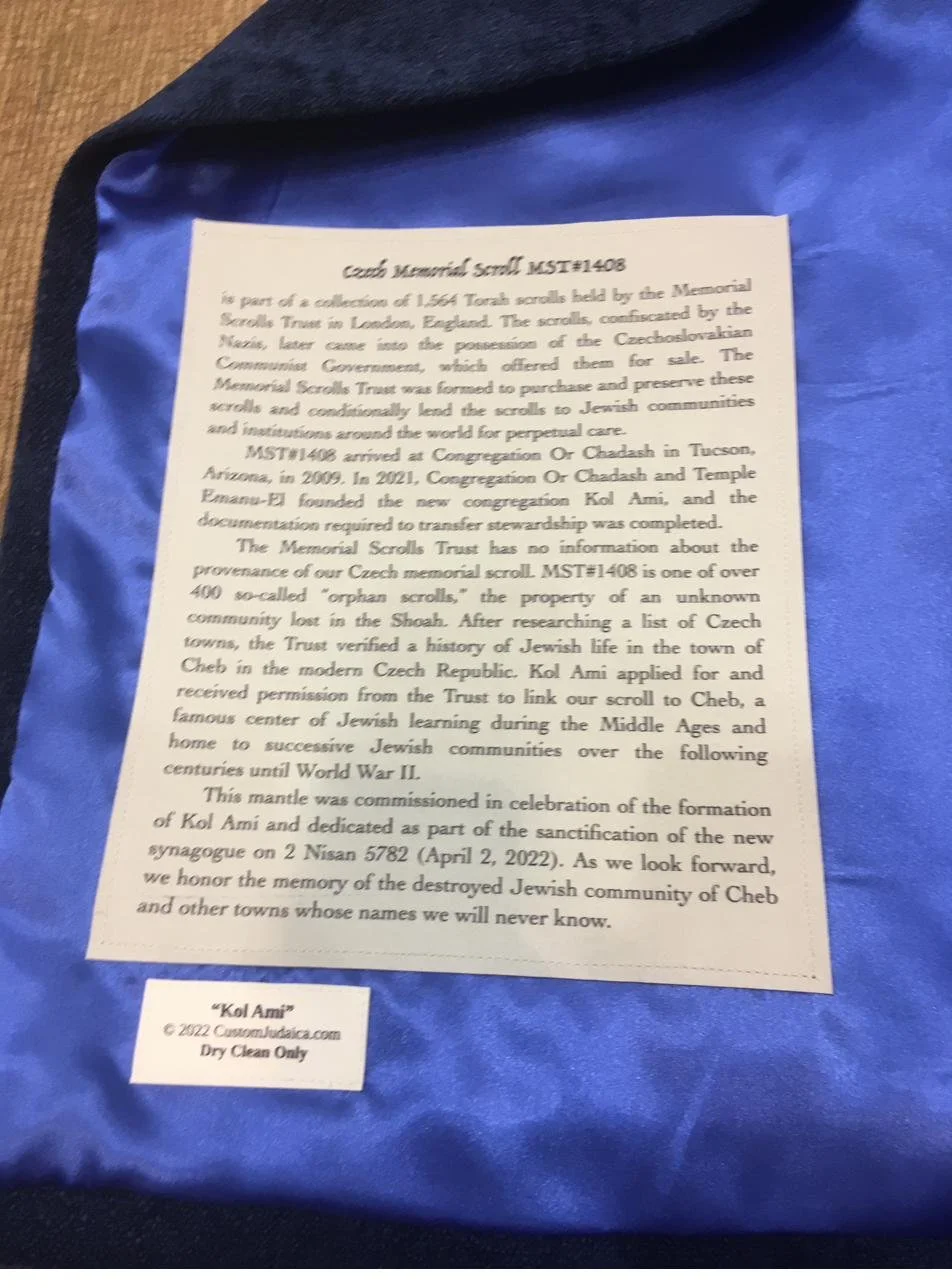
Inside the everyday mantle, the embroidered card with the scroll’s history.
Kol Ami, and Or Chadash before it, have tried to ensure that the scroll remains a central component of the congregation’s religious life. For example, on May 18, 2024, four adult members of Kol Ami, Sue Cohn, Ty Condon, Pat Eisenberg, and Susan-Marie Flanigan, celebrated becoming b’nei mitzvah by chanting from MST #1408, to date the only adult b’nei mitzvah class to have read from the scroll. Given Sue’s history with the scroll, it was an easy decision to request that they chant from it.
Because the scroll’s column layout differs from a standard Tikkun, preparing to read from it posed its own challenge. The class began with studying their individual parashot from Plaut’s The Torah: A Modern Commentary, 2nd edition, and recordings prepared by Cantor Janece Cohen, with additional support from Sarah Bollt, then a cantorial student completing her final semester. After Rabbi Druin repaired parsha Emor to render it kosher for reading, each celebrant photographed the relevant columns and practiced from those photographs at home, and the class rehearsed from the scroll itself before the service. The learning, as ever, was in the doing. In the synagogue on the morning of the b’nei mitzvah stood a binder on the history of Cheb, compiled by Susan-Marie Flanigan, alongside a visual display created by Pat Eisenberg that included pictures of the synagogue and other materials.
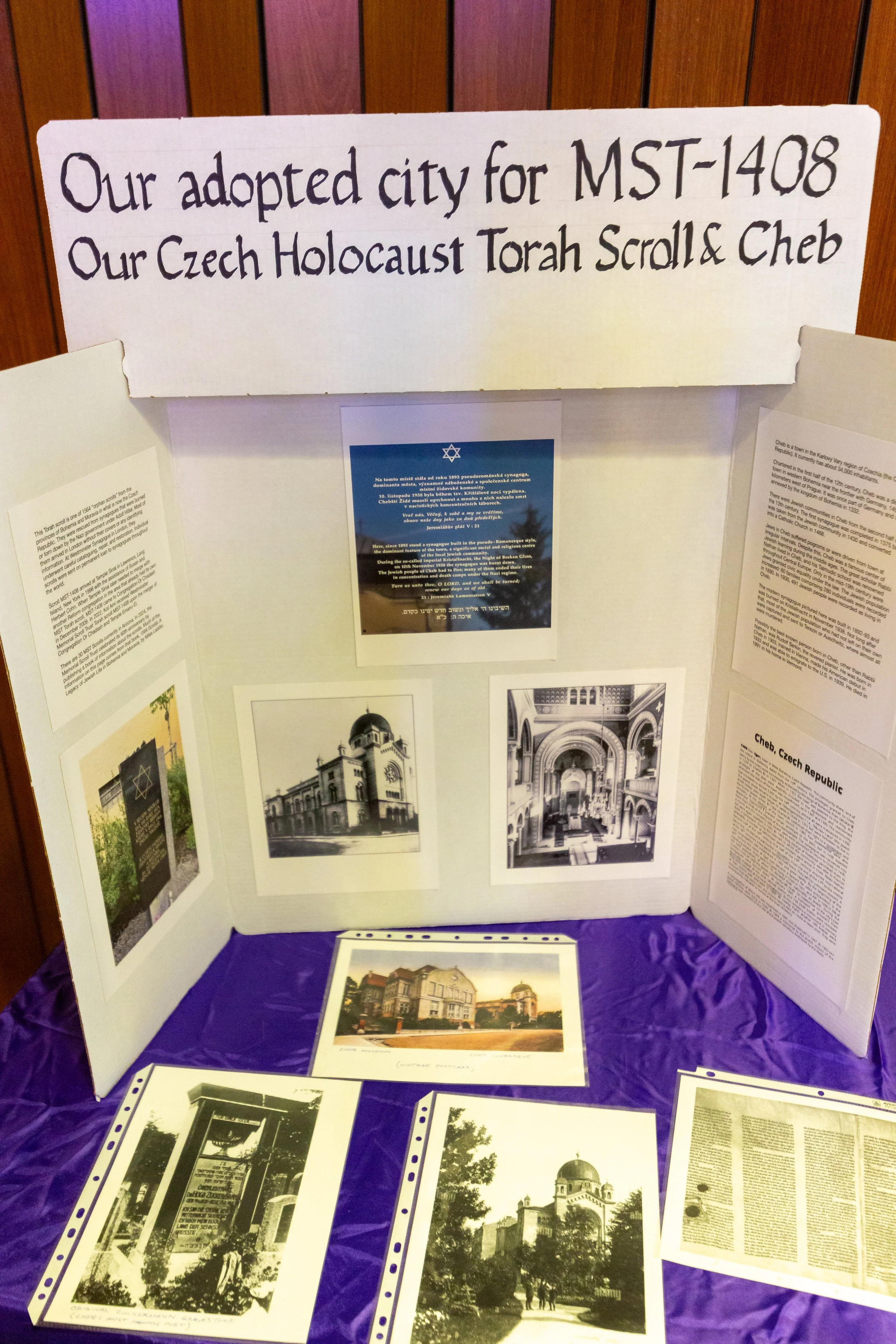
Table display of photographs and materials about the Jewish community of Cheb.
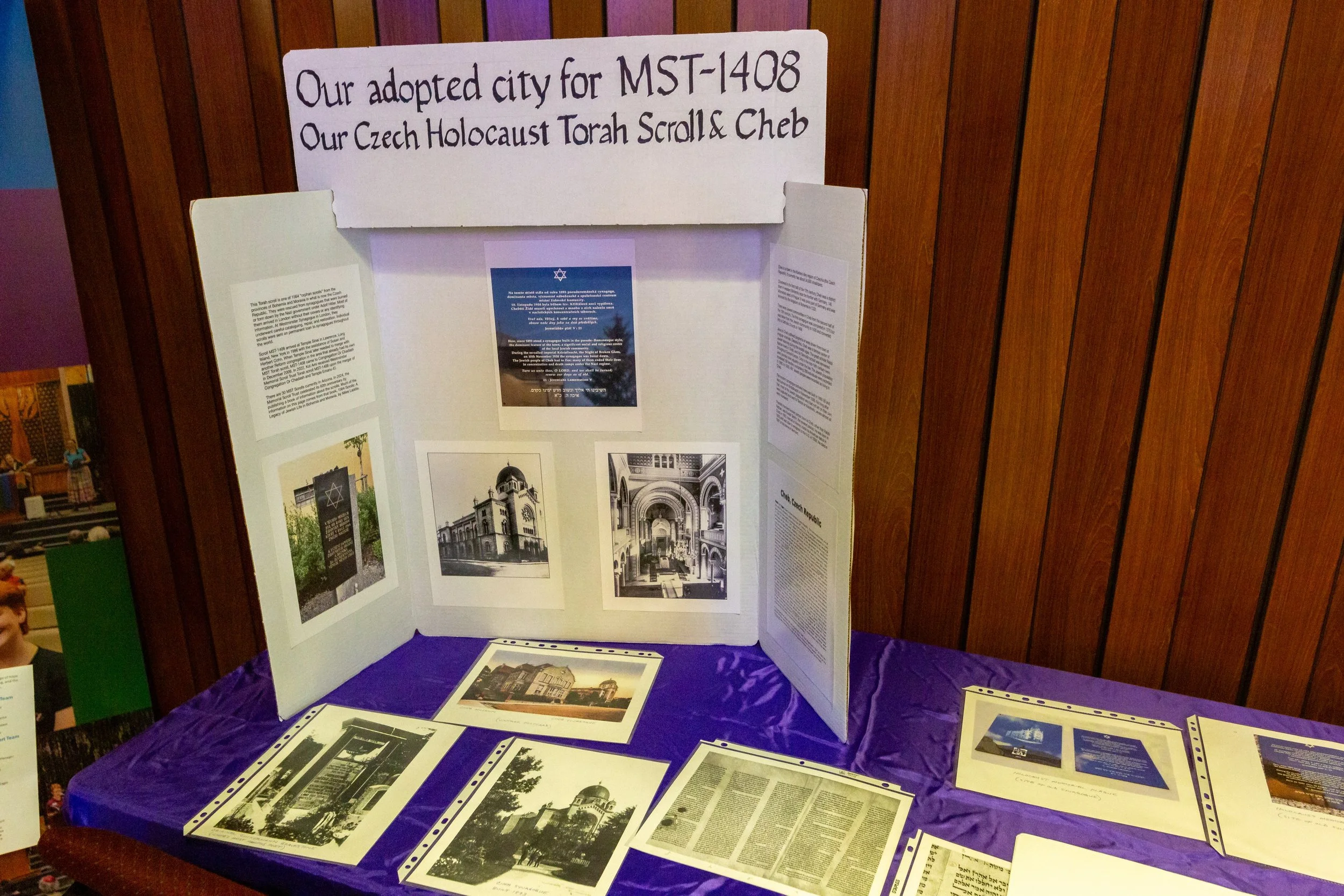
The Cheb research display at the May 18, 2024 adult b’nei mitzvah service.
Additionally, a hand-made wimple, a binding sash bearing each celebrant’s Torah verses and Hebrew name, was created by Susan-Marie Flanigan for the scroll for the service.
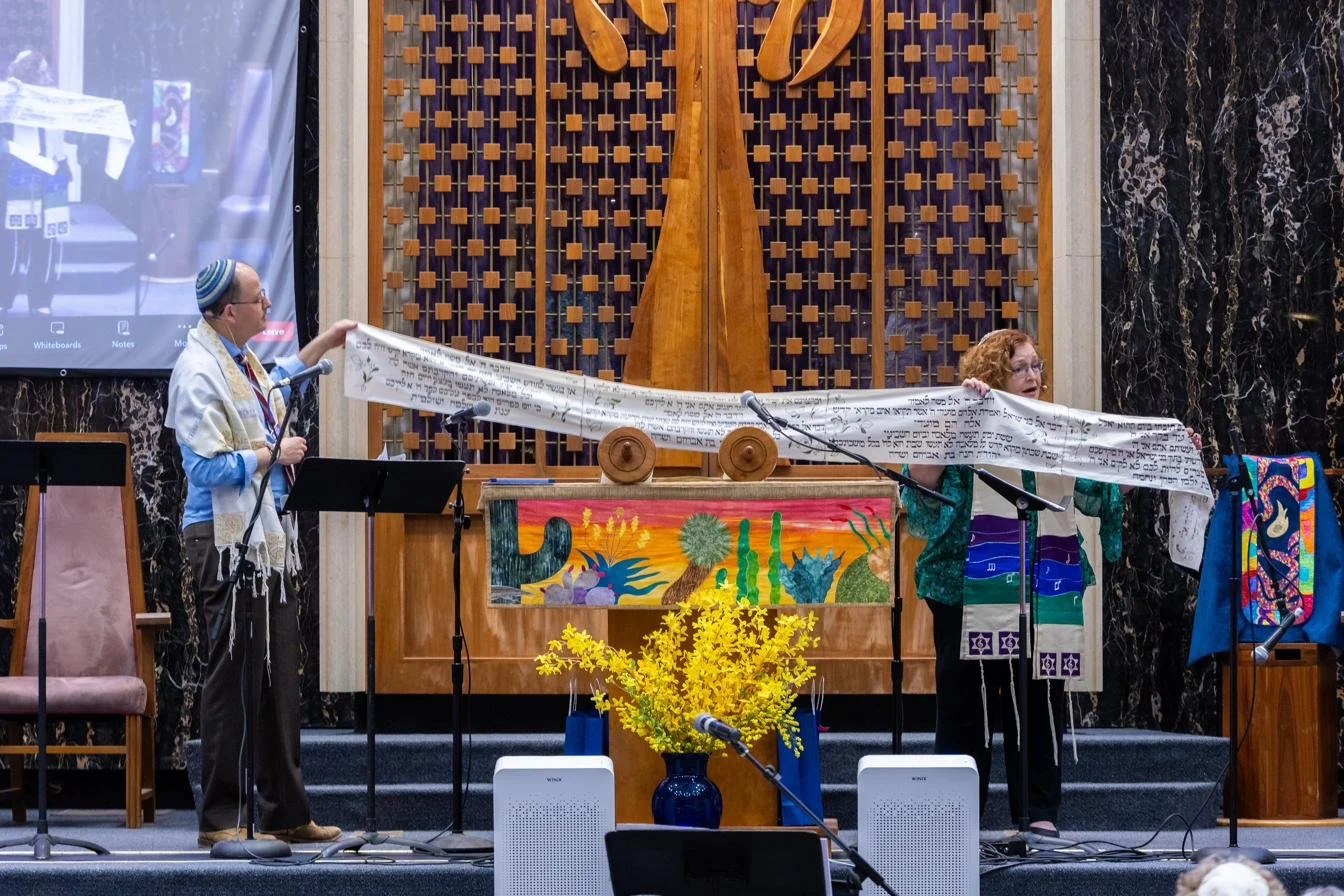
The hand-made wimple created by Susan-Marie Flanigan for the May 18, 2024 adult b’nei mitzvah service, bearing each celebrant’s Torah verses and Hebrew name.
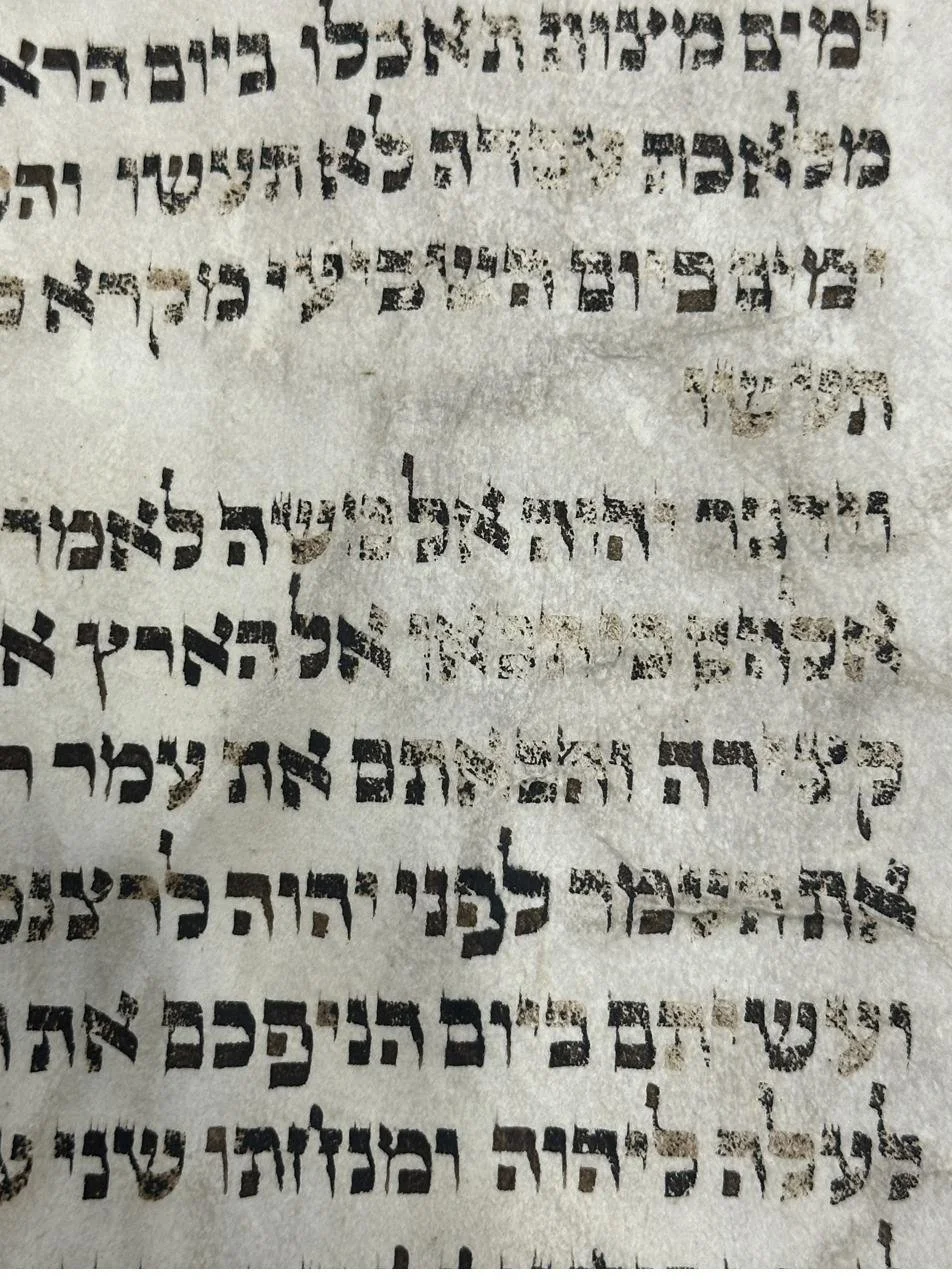
Parsha Emor before and after repair.
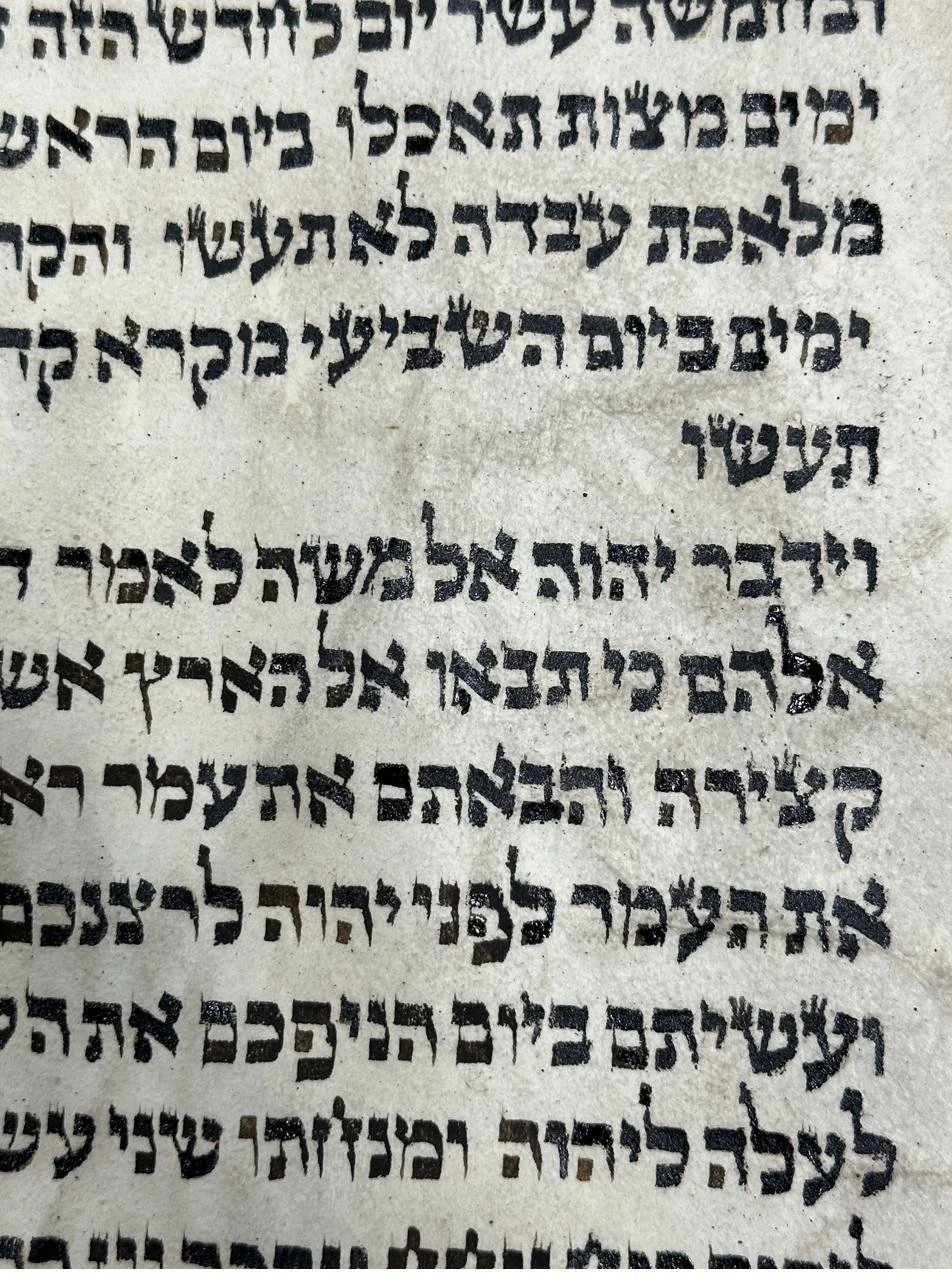
Parsha Emor before and after repair.
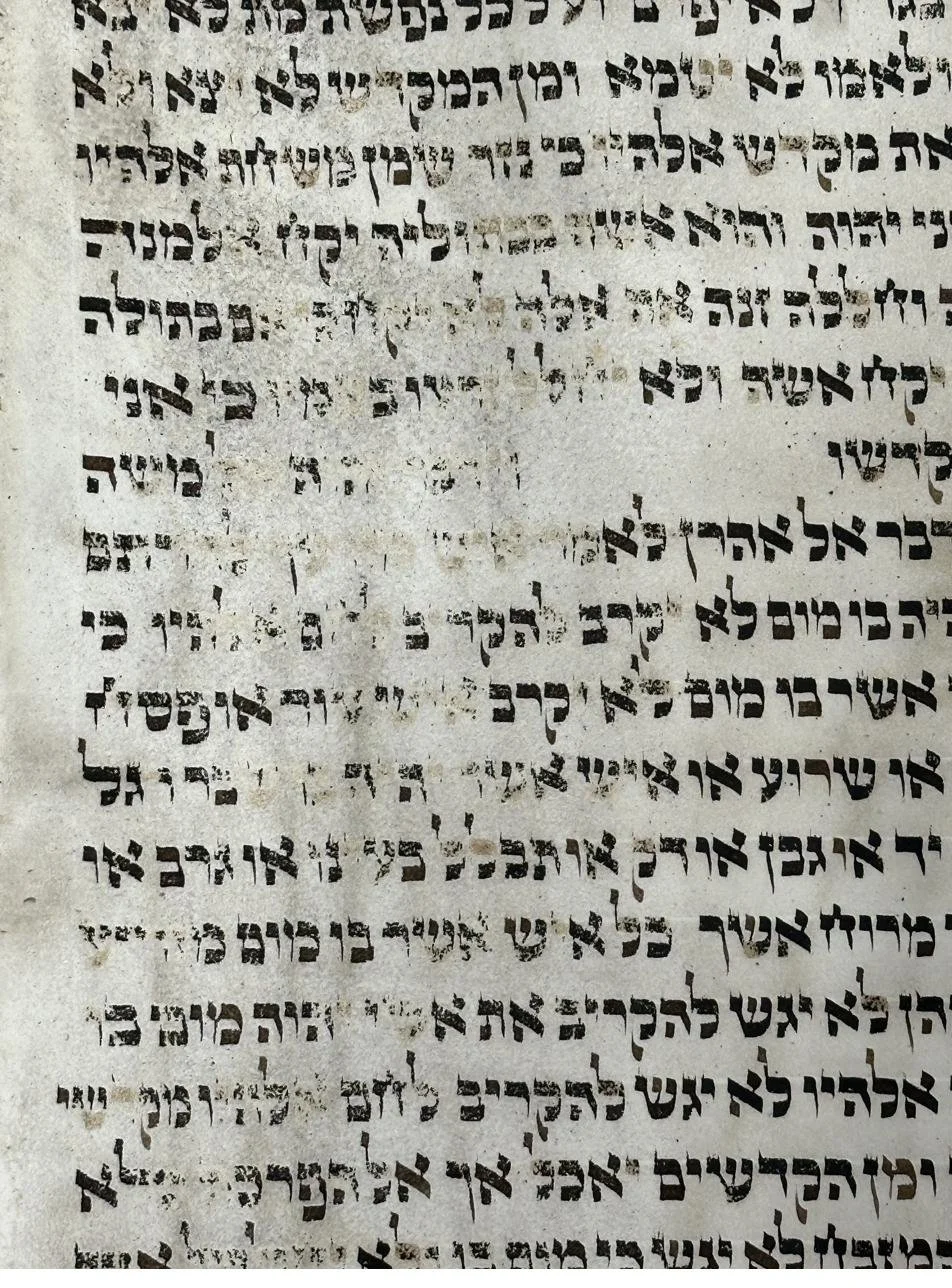
Parsha Emor before and after repair.
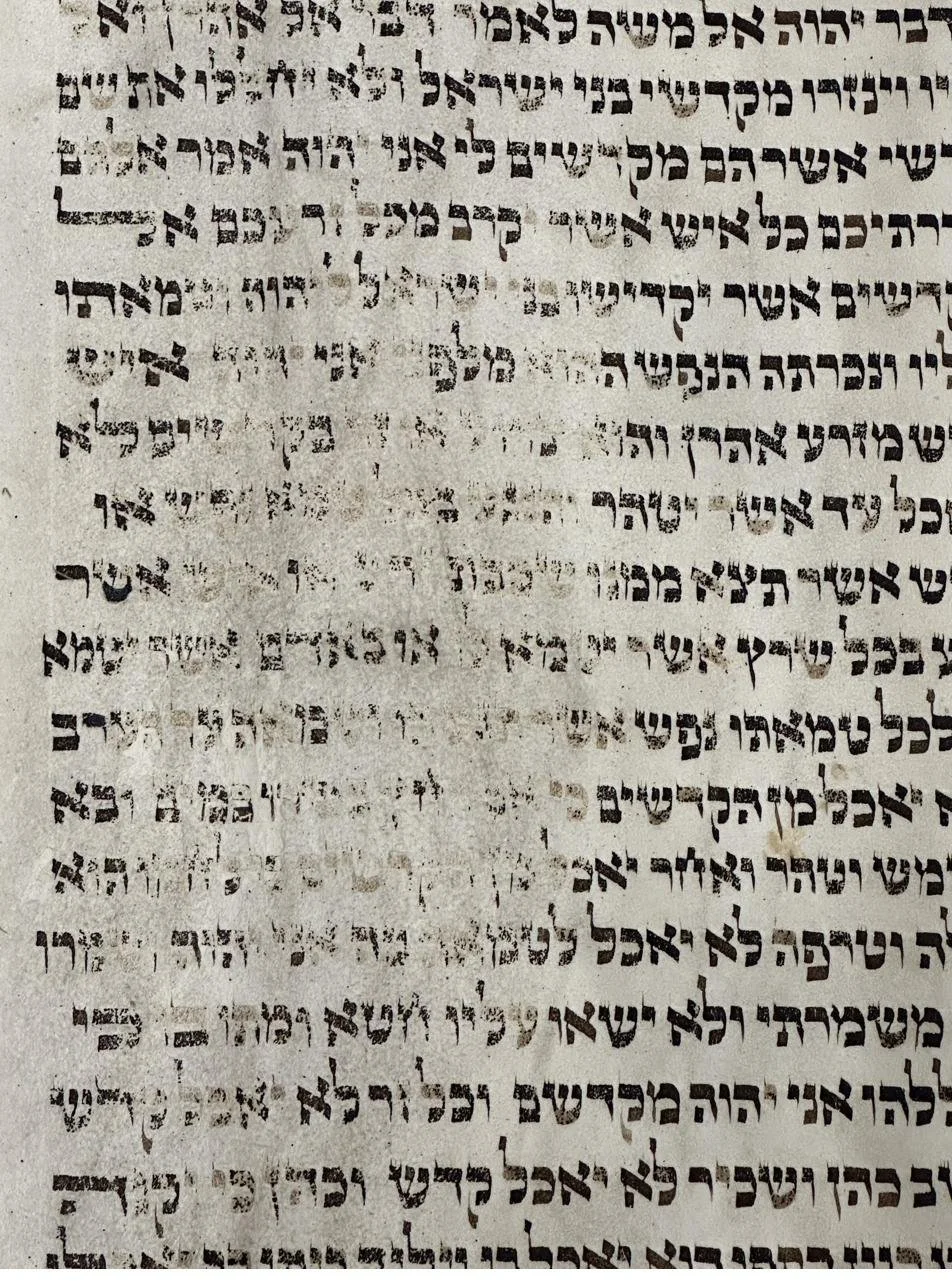
Parsha Emor before and after repair.
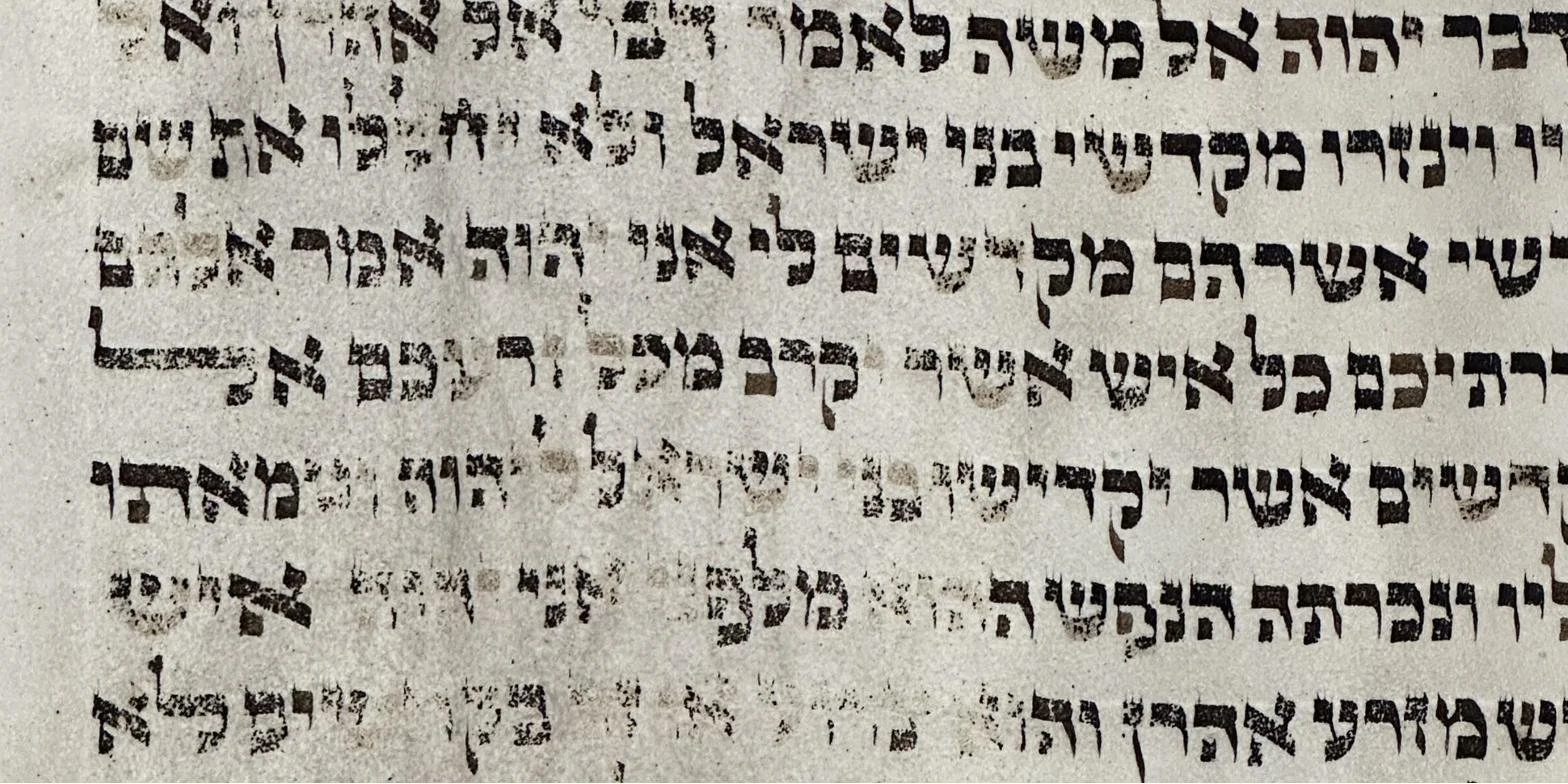
Parsha Emor before and after repair.
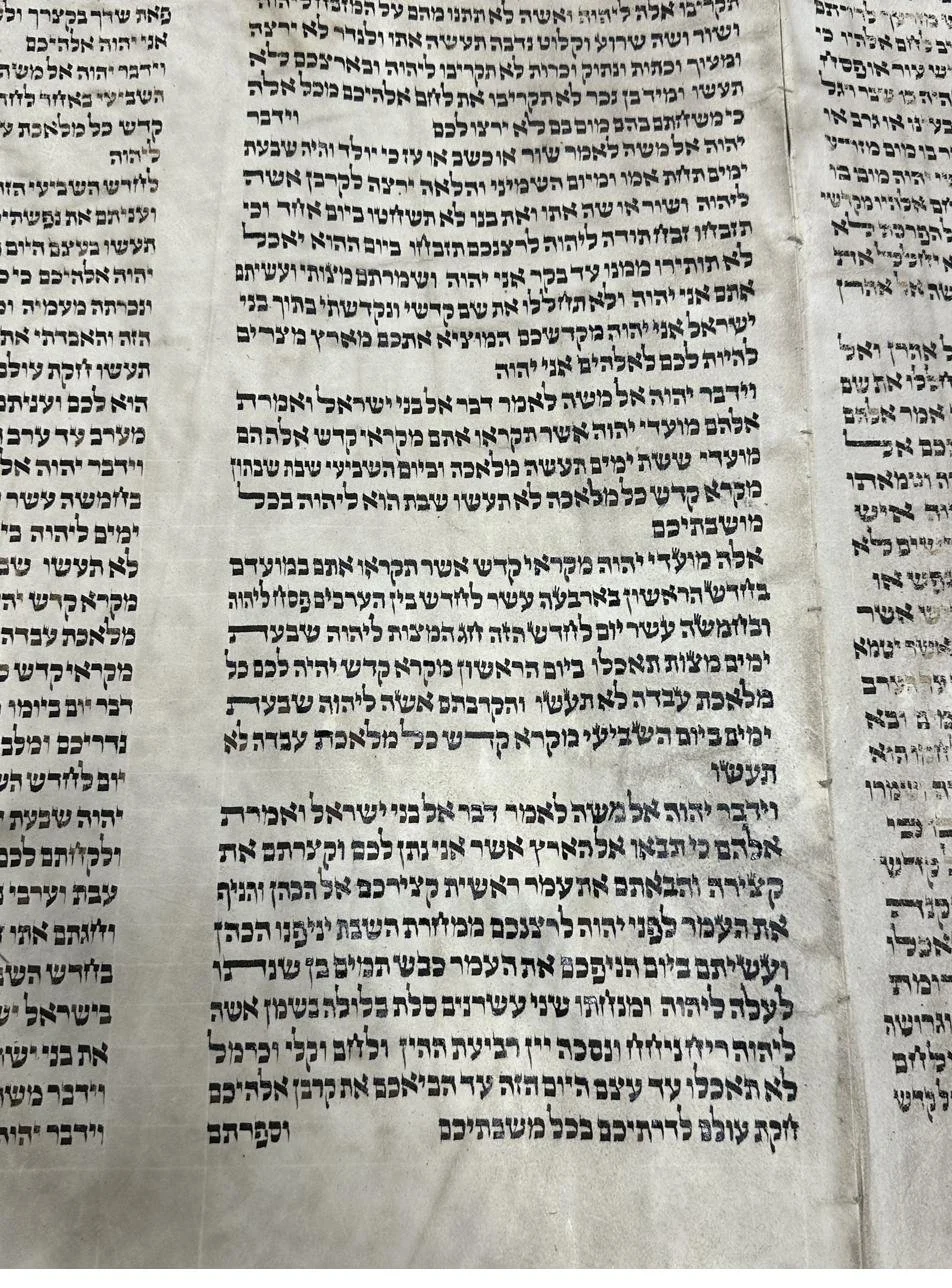
Parsha Emor before and after repair.
In April 2025, the historian Jitka Mlsová Chmelíková, who has researched the Jewish community of Cheb in greater depth than any other scholar, visited Kol Ami in person and presented her research to the congregation. On the final day of Passover, April 19, the congregation wove the story of Cheb through its morning service: chanting from the Czech scroll, viewing photographs of the town’s history, and reading aloud the names of some of its Jewish victims before reciting Kaddish.
As Rabbi Malcolm Cohen told the congregation that Shabbat, “Even though the Jewish community of this town has been wiped off the earth, we have a duty to talk about the people who lived there and ensure that this group of Jews is memorialized somehow.”
Sources
Phyllis Braun, “Ceremony Honors Rescue of Holocaust Torah Scrolls,” Arizona Jewish Post, March 12, 2024; Phyllis Braun, “Adult B’nai Mitzvah Class at Kol Ami Celebrates with Czech Scroll,” Arizona Jewish Post, 2024; “Kol Ami History,” Kol Ami Synagogue, katucson.org/synagogue-history; “Czech Torah Presentation & Sanctification,” Kol Ami Synagogue internal document, April 2, 2022; “Cheb Intro,” Kol Ami Synagogue internal document; “Czech Memorial Scroll MST#1408,” Kol Ami Synagogue internal document; Emily Joseph, email message to Susan-Marie Flanigan, June 26, 2026; firsthand recollection of class member Susan-Marie Flanigan, 2026; Sue Cohn, study session with Susan-Marie Flanigan (Emor correction detail); Sue and Herb Cohn, interview with Susan-Marie Flanigan, Tucson, Arizona, July 8, 2026; Sue Cohn, email to Susan-Marie Flanigan, July 14, 2026; “MST #1408: In Memory and Honor,” statement provided by Sue Cohn, July 2026; Memorial Scrolls Trust, letter of assignment of Scroll No. 1408 to Temple Sinai of Long Island, signed Ruth Shaffer, Joint Chairman and Trustee, March 1996; Sue Cohn, bat mitzvah sermon, Kol Ami, May 18, 2024; Rabbi Thomas A. Louchheim, “Shavuot: A Marriage of Torah and Or Chadash,” The New Light (Congregation Or Chadash newsletter), May–June 2010; Sheila Wilensky, “At Shavuot, Or Chadash to Dedicate Orphan Torah Scroll,” Arizona Jewish Post, May 7, 2010; Memorial Scrolls Trust, “MST Scroll: Formal Hand Over Event: Receipt,” December 4, 2009; ketubah of MST #1408 and Congregation Or Chadash, May 21, 2010 (8 Sivan 5770); Rabbi Thomas A. Louchheim, letter to Sue and Herb Cohn, May 25, 2010; “2010 Dedication of Our Memorial Scroll at Congregation Or Chadash,” Kol Ami congregational document; “Kulanu b’Yachad” service script, April 2, 2022, Kol Ami congregational document; “Czech Torah Presentation,” April 2, 2022, Kol Ami congregational document; Radana Šusilová, Jewish Museum in Prague, email to Herb Cohn, December 18, 2009; Rabbi Malcolm Cohen, Shabbat message to Kol Ami congregation, April 18, 2025.
Caring for Our Scroll
The Memorial Scrolls Trust (MST) asks every congregation holding a scroll on permanent loan to make a long-term commitment to that scroll’s spiritual and educational life. Under the terms of the loan, the rabbi and the leaders of the congregation “pledge to dedicate one Shabbat every year to the Jews of their Memorial Torah Scroll – the people, their community, their fate and their heritage.” In the Trust’s words, “Each Scroll is a messenger from a martyred community that depends on its new community to ensure that their heritage is cherished as well as their remembrance as individuals.”
The commitment is physical as well: The 2024 repair that prepared the scroll for the adult b’nei mitzvah service was partial: parsha Emor was returned to a kosher state, with the hope, voiced by Sue Cohn from the bimah, that regular use would help maintain the scroll until it could be koshered in its entirety. Less than two years later, MST #1408 underwent letter-by-letter restoration by Rabbi Druin during the congregation’s February 2026 maintenance visit and is enrolled in an ongoing five-year Torah maintenance plan.
See the photographs of the Emor repair earlier on this page.
This page exists, in part, to help fulfill that obligation.
The connection to London remains a living one. In the summer of 2026, Sue and Herb Cohn visited the Memorial Scrolls Trust at Kent House in London, where they met for several hours with Jeffrey Ohrenstein, Trustee and Chairman of the Trust, and saw the vault and repair rooms where the scrolls still in the Trust’s care are kept.
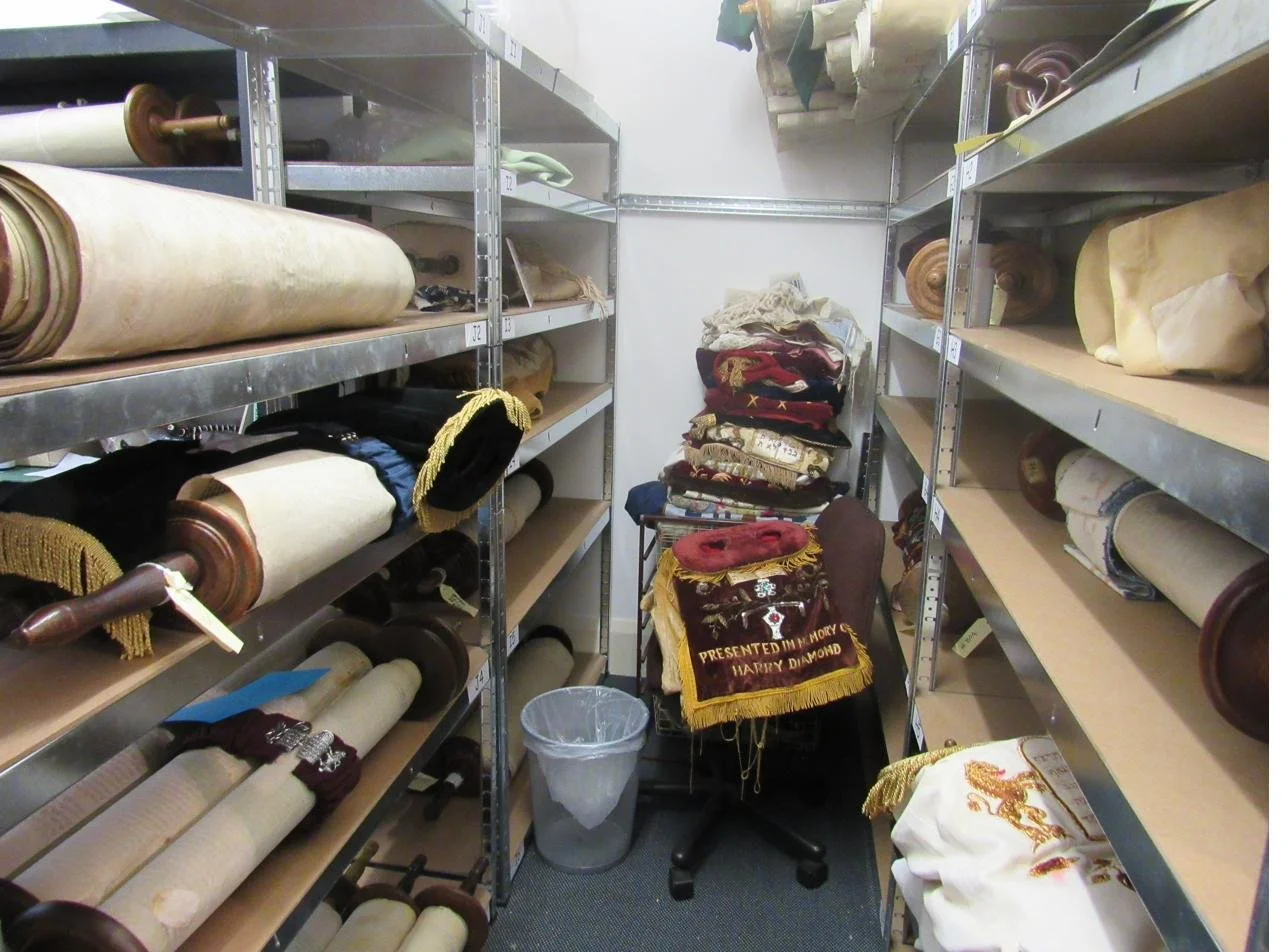
Sue and Herb Cohn with Jeffrey Ohrenstein, Trustee and Chairman of the Memorial Scrolls Trust, at Kent House in London, summer 2026, and the Trust’s scroll vault and repair rooms.
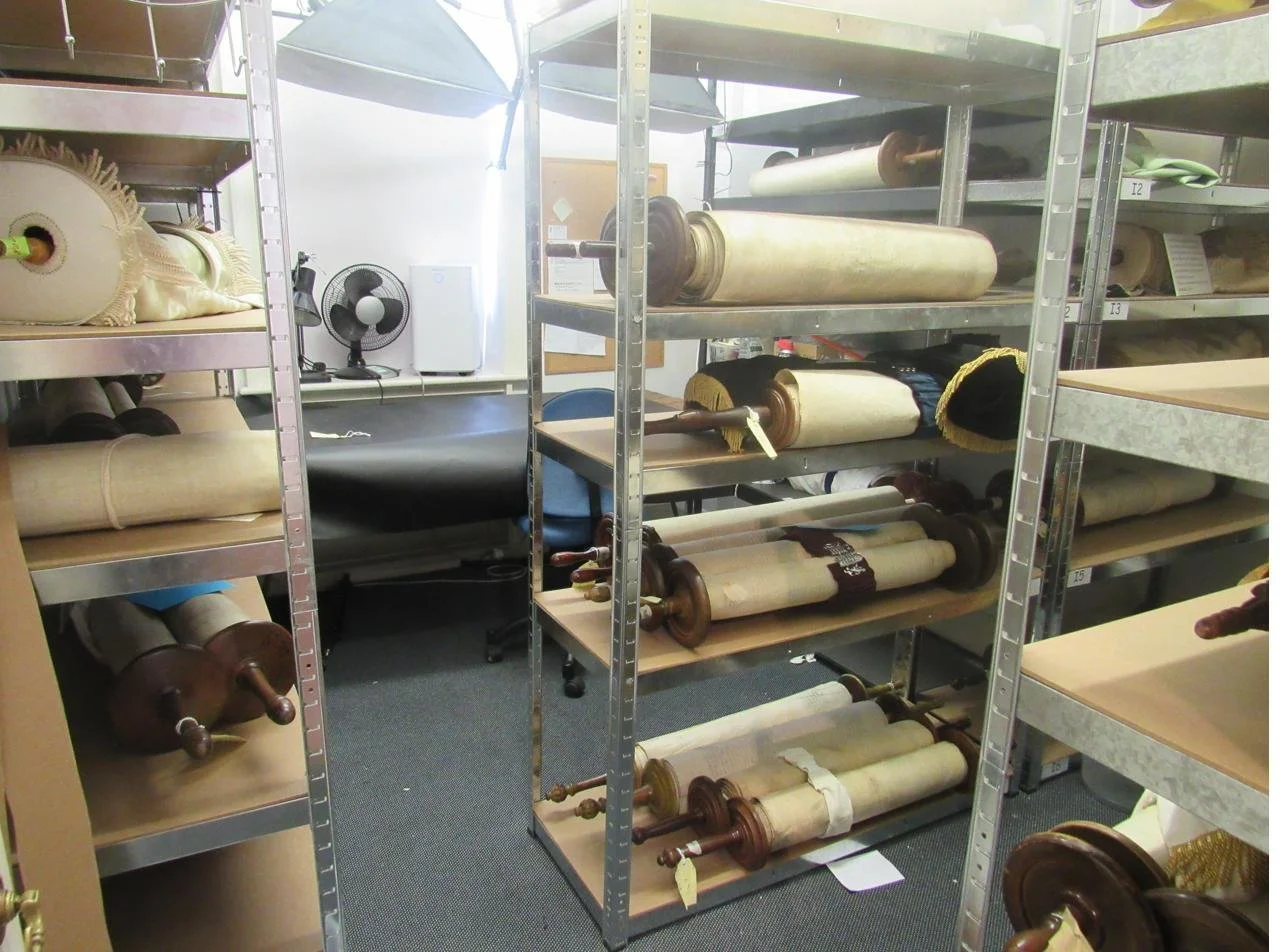
Sue and Herb Cohn with Jeffrey Ohrenstein, Trustee and Chairman of the Memorial Scrolls Trust, at Kent House in London, summer 2026, and the Trust’s scroll vault and repair rooms.
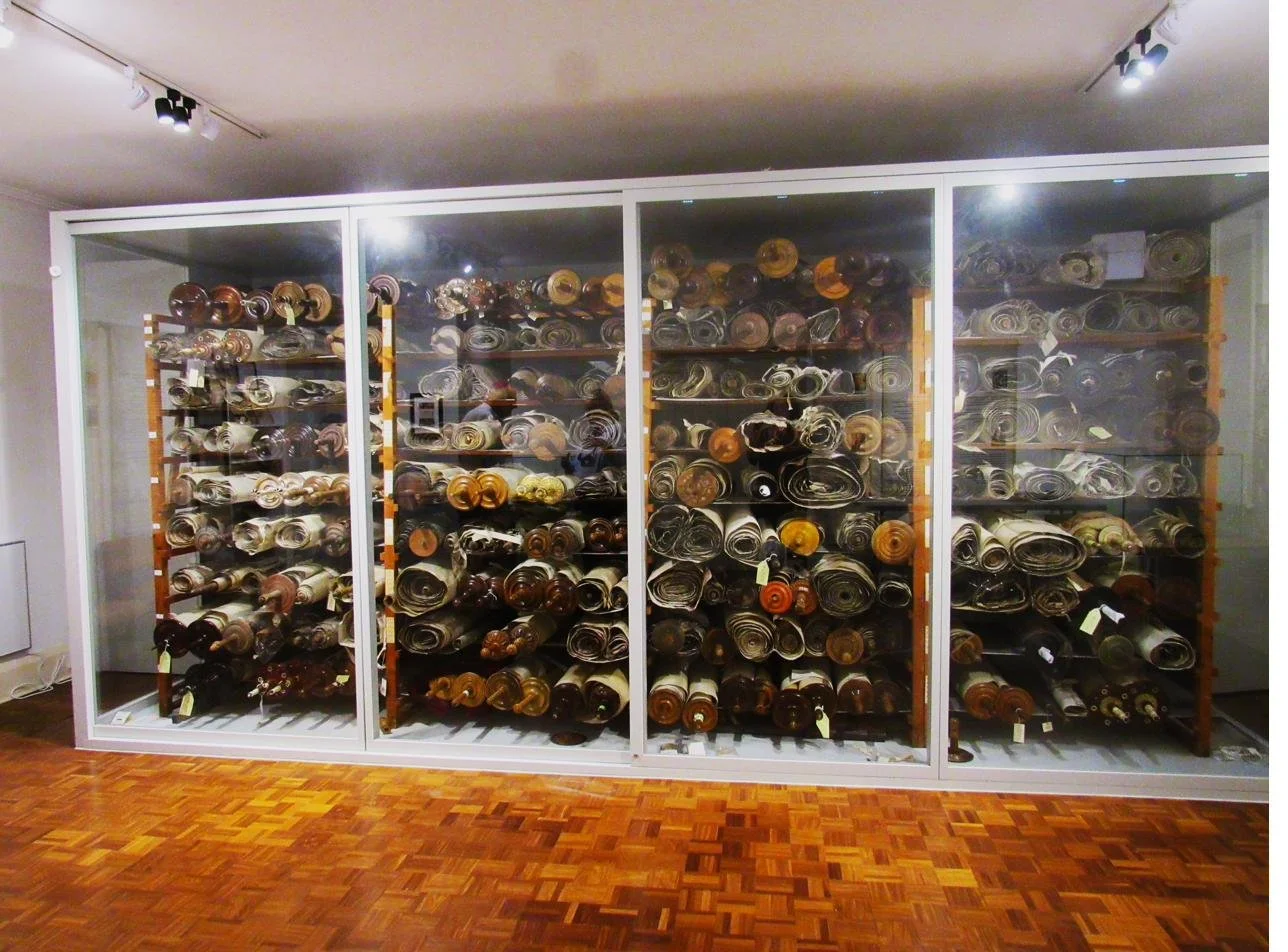
Sue and Herb Cohn with Jeffrey Ohrenstein, Trustee and Chairman of the Memorial Scrolls Trust, at Kent House in London, summer 2026, and the Trust’s scroll vault and repair rooms.

Sue and Herb Cohn with Jeffrey Ohrenstein, Trustee and Chairman of the Memorial Scrolls Trust, at Kent House in London, summer 2026, and the Trust’s scroll vault and repair rooms.
The Cohns have borne most of the scroll’s costs from the beginning: the initial $1,500 that obtained it in 1996, the $5,000 to move it to Tucson, the scroll’s own airplane seat, the High Holy Days mantle, and the $6,000 donation to Kol Ami for the repair to parsha Emor that rendered the scroll kosher for the 2024 adult b’nei mitzvah service.
The scroll lives in the congregation’s year, not behind glass. On April 19, 2025, the seventh day of Pesach, it stood at the center of Kol Ami’s Yizkor service of remembrance for the town of Cheb. Emily Joseph offered remarks on the Trust, the scroll, and the adoption of Cheb while photographs of the synagogue, Rabbi Israel Schapira, and the town’s memorials were shown; Rabbi Thomas Louchheim helped undress the scroll for the Torah service and chanted first; the congregation stood as Cantor Jennifer Benrey chanted the Song of the Sea; Torah blessings were shared by Kathylynn Saboda, Celia Slatzer, and Art and Sharon Geiger; and the names of Nazi victims were read during Kaddish. The congregation also sang “Komáři se ženili” (“The Gnats’ Wedding”), a folk song from the Terezín concentration camp. On April 4, 2026, the scroll was carried through the congregation in the hakafah by Susan-Marie Flanigan; Herb Cohn offered the first blessing over it, Susan Simon the second, and Gretchen Brittain the third; and the Terezín folk song was sung again, this time as a round. A custom is quietly forming around the scroll.
That April morning, Rabbi Malcolm Cohen framed what the scroll asks of its keepers. Cheb is a community that can no longer tell its own story, and Kol Ami has taken that story on: “We are taking someone else’s story on for them.” The congregation is not permitted to keep this Torah, he taught, unless it tells the story of where the scroll came from, of Westminster Synagogue, and of the town to which it is linked. Not only does Kol Ami have its own story; it has Cheb’s, to nurture and keep safe.
This scroll has been cared for by many hands: the hands that made it; the hands that held it, blessed it, chanted from it, and lifted it for all to see; the hands that hid it and saved it; the hands that restored it in London and, more recently, here in Tucson. Ours are simply the newest. Through all of these hands, the past and the present are forever intertwined.
- Memorial Scrolls Trust: memorialscrollstrust.org
- Czech Memorial Scrolls Museum (Westminster Synagogue, London): westminstersynagogue.org
Sources
Memorial Scrolls Trust, “Conditions of Loan,” January 2016; sofer’s Torah maintenance chart, visit of February 8–10, 2026, Kol Ami congregational records; Sue and Herb Cohn, interview with Susan-Marie Flanigan, Tucson, Arizona, July 8, 2026; Sue Cohn, bat mitzvah sermon, Kol Ami, May 18, 2024; photographs from the Cohns’ summer 2026 visit to the Memorial Scrolls Trust, Kol Ami congregational files; notes from the Shabbat Passover morning and Yizkor service, April 19, 2025, and the Shabbat morning service with the Czech Torah, April 4, 2026, Kol Ami congregational records.
Cheb (Eger): A Community Through the Centuries
Ancient Roots
The Jewish community of Cheb, known for most of its history by its German name Eger, is considered among Bohemia’s oldest, with a documented presence dating to the thirteenth century. The Bohemian kings recognized and protected this community. Rulers confirmed the community’s privileges again and again, from Ottokar II in 1266 through Charles IV in 1347. Even when the town was pledged to the Bohemian crown in 1322, the community’s rights were written into the terms of the deal.
By the mid-fourteenth century, Jews made up approximately a quarter to a third of the town’s population. (Some chroniclers put the community at almost 3,000 individuals, a figure Chmelíková’s research judges improbable.) Then, disaster struck in 1350. On Maundy Thursday, March 25, 1350, an unnamed Franciscan monk preached a vivid sermon on the sufferings of Christ. A mercenary in the congregation seized a crucifix from the altar and called on the crowd to avenge Christ’s death. The armed mob descended on the ghetto and murdered the majority of Cheb’s Jews. A handful escaped, most taking refuge in nearby Kynšperk. Contrary to medieval chroniclers’ claims, the community was not wholly annihilated: Jews returned within a few years, and the tombstone of a Jewish woman named Kejle, dated 1353, attests to the rebuilt community. Charles IV pardoned the town for the massacre by charter on May 18, 1350, in exchange for a fine. The lane where much of the killing occurred is known in German sources as the Mordgässchen (“Murder Lane”) and in Cheb, unofficially, to this day as Zavražděných (“Street of the Murdered”), a name that has continued to haunt the town’s geography ever since.
The community was repeatedly rebuilt, expelled, and rebuilt again over the following centuries. Jews resettled in Cheb in 1352, were granted rights to a synagogue and cemetery by Charles IV in 1364, and saw four Judenmeister appointed to the town council in 1386. Sigismund I expelled them in 1430 at the demand of the townspeople, and the synagogue was given over for conversion into a church, though it was not consecrated as the Church of the Visitation of the Virgin Mary until December 8, 1468. Jews returned in 1435, and King George of Poděbrady allowed them to build a new synagogue in 1463. They were expelled again in 1502. During those intervals of relative peace, Cheb was a center of Jewish learning. Rabbi Nathan, active in Cheb in the late fourteenth and early fifteenth centuries, was known throughout the Jewish world, and he was eventually buried in Jerusalem.
From roughly the late seventeenth century to the mid-eighteenth century, only a small handful of Jewish families remained in Cheb, and even they eventually departed for reasons that history does not record.
Sources
Isaac Ze’ev Kahane and Yeshayahu Jellinek, “Cheb,” in Encyclopaedia Judaica, 2nd ed. (Detroit: Macmillan Reference USA / The Gale Group, 2008); Klaus-Dieter Alicke, “Eger (Böhmen),” in Aus der Geschichte der jüdischen Gemeinden im deutschen Sprachraum, jüdische-gemeinden.de; Jitka Chmelíková, Osudy chebských Židů: Chebstí Židé od 2. poloviny 19. století do současnosti (Cheb: Krajské muzeum Cheb, 2004), pp. 6–15.
A Modern Community: Rise and Flourishing
Jewish families began returning to Cheb in significant numbers only after legal emancipation gave them the right to settle freely. A few families had been quietly tolerated earlier, among them the Oppenheimer family from the late eighteenth century, and about three families were recorded in the town in 1849. The first Jew officially recorded as permitted to settle in Cheb after centuries of exclusion was Ariel Löwy, a banker from Kynžvart (Königswart), in 1853. Löwy bought two houses in the town. A religious association formed in 1862, and within a decade, on September 1, 1872, a formal Jewish Religious Community (Jüdische Religionsgemeinde) was established. The center of Jewish religious life from 1854 was the house of community founder Naphtali Zuckermann on Schulgasse, where services were held in a converted attic room in the 1860s. In 1869, the community purchased the former inn Zur böhmischen Krone on Schiffgasse and dedicated a proper prayer hall there in 1870.
By the 1880s, the prayer hall could no longer hold the growing congregation. A general assembly in October 1884 resolved to acquire land and build a true synagogue, a goal that took years of fundraising to achieve. The magnificent new synagogue was finally constructed at the corner of Gschierstraße and Ringstraße, built in the pseudo-Romanesque style with Byzantine influence. It was inaugurated in the summer of 1893. The three-aisled basilica rose to a monumental cupola with a gilded spire on its western facade, with smaller cupolas at each corner, all visible from across the city. The vestibule interior was lined with sixteen sandstone columns connected by a Romanesque vault and richly decorated paintings. On the floor above the women’s gallery, beneath the great cupola, stood the organ, crafted in the workshop of Martin Zaus, the same artisan who built the organ for the Church of St. Nicholas in Cheb. The main nave soared fifteen meters from floor to ceiling, and the semi-circular apse at the eastern wall, oriented toward Jerusalem, housed the aron ha-kodesh (Torah ark) in the form of a miniature domed temple with a colonnaded entrance. Before it stood the almemor, the raised reading platform with its desk and candlesticks, where the Torah was unrolled and read aloud. The painted ceiling and dome depicted a sky filled with stars. Most of the interior artwork is attributed to local Cheb artist Andreas Pabler, and all craftsmen involved in the construction were from the city itself. It was described as the dominant architectural feature of Cheb, a proud and visible statement of Jewish belonging in the life of the town.
On the day of its dedication, the congregation held a final morning service in the old prayer room at the former inn Zur böhmischen Krone, then formed a procession through the streets to the new synagogue. Four festively decorated Torah scrolls were carried on two wagons, two scrolls per wagon, accompanied by the entire community. It was the old making way for the new, the Torah scrolls themselves bridging the thresholds of the prayer room and the synagogue.
The community grew steadily through the late nineteenth century: 384 members in 1880, 508 by 1890, and a peak of 554 in 1900. In 1921, 505 Jews lived in Cheb; in 1930, 491; and on the eve of 1938 the community numbered roughly 550. The community maintained a Jewish Women’s Association, sports clubs (including the Maccabi organization and Techeleth Lavan), the women’s Zionist organization WIZO, and active ties to the broader currents of Jewish life in Bohemia and Moravia.
Rabbi Dr. Arnold Grünfeld led the congregation from 1913 to 1927 before leaving for Jihlava. Rabbi Dr. Israel Schapira arrived from Berlin in 1928 and served until 1935. Schapira was well-liked by most congregants, but he was viewed with suspicion by others who considered him too sympathetic to Reform Judaism. He left Cheb for Antwerp in 1935. After the German conquest of Belgium, Schapira’s family fled to France in 1941 and made their way via Casablanca, Morocco, to Havana, Cuba. Schapira returned to Antwerp in December 1945 and died there in 1963. The community’s last rabbi was Isidor Sud, who served from 1935 to 1938. Born in Samgorodok, Ukraine, Sud left for Prague in 1938 and is reported to have emigrated to the United States, where he served as a rabbi in New York.
Yet even as the Jewish community flourished, Cheb had long been a center of German nationalist and antisemitic sentiment. By the early twentieth century, the name “Eger” had become, in the words of the Encyclopaedia Judaica, “a byword for rabid antisemitism in the Hapsburg empire.” The political atmosphere darkened considerably in the 1930s as the Sudeten German nationalist movement, which maintained a central office in Cheb’s Hotel Viktoria, aligned itself with Nazi Germany.
Sources
Kahane and Jellinek, “Cheb,” Encyclopaedia Judaica (2008); Alicke, “Eger (Böhmen),” jüdische-gemeinden.de; Chmelíková, Osudy chebských Židů, pp. 31–42, 45–46, 50, 76–90; synagogue memorial plaque, Cheb, Czech Republic, 2020; Rabbi Malcolm Cohen, Shabbat message to Kol Ami congregation, April 18, 2025.
World War I and the Refugees of Galicia
The First World War placed enormous demands on the Cheb Jewish community. Hundreds of thousands of Jewish civilians fled westward into the interior of the monarchy when Russian forces swept through the Austro-Hungarian territories of Galicia (Halyč) and Bukovina beginning in the autumn of 1914. Many came to Cheb.
On the morning of November 15, 1914, the first large transport arrived. The official count shows 334 exhausted refugees. They were overwhelmingly women, elderly people, and children, most from the districts of Tarnów and Bochnia. Ordered to flee by the authorities, they had been able to save little more than their lives. The refugees were housed in the town’s old spinning mill, where women from the Jewish Women’s Association immediately prepared the first meal for the hungry and frost-bitten travelers.
The Cheb Jewish community organized a formal relief committee within days, chaired by Eduard Löwy, the long-serving chairman of the Jewish Religious Community. Each aspect of the relief effort had an assigned leader: Rabbi Dr. Grünfeld for public aid, Dr. Grünhut for legal protection, Dr. Zentner for kitchen management, Dr. Glaser for medical care, Dr. Kraus for finances, Ferdinand Koretz for transport, Viktor Gelber for oversight, Wilhelm Herrmann for housekeeping, Isidor Springer for donations, and chief cantor Armin Wilkowitsch, the community’s own historian, for reporting and translation. The relief effort was methodical, humane, and sustained over several years.
By June 1, 1915, the number of refugees in the Cheb district had reached 1,167. The Jewish community raised money, improved conditions at the mill and helped families move gradually into private apartments, managed quarantine outbreaks (including a confirmed case of cholera in November 1914), and helped families navigate conscription, repatriation, and the journey home when the territories were eventually retaken.
Not all the refugees survived their stay in Cheb. Approximately 30 were buried in the Jewish cemetery there during the war years, roughly a third of them children aged eleven or younger. They died of pneumonia, bronchitis, tuberculosis, and kidney inflammation, or were stillborn. They rested in the Cheb cemetery until it was razed under the Nazis in 1944. Their names, like so much else, were lost.
Source
Chmelíková, Osudy chebských Židů, pp. 52–67.
Destruction: 1938 and Beyond
The annexation of the Sudetenland by Nazi Germany in late September and early October 1938 sealed the fate of Cheb’s Jewish community. As Dr. Lenka Šindelářová of the Jewish Museum in Prague described: “The vast majority of Cheb’s Jews left the town, some managed to emigrate, some moved to the interior of Czechoslovakia, those who remained were suddenly in the territory of the Third Reich.”
On the night of November 9 to 10, 1938, known as Kristallnacht, or the “Night of Broken Glass,” the great 1893 synagogue on the Ringstraße, the architectural pride of the community, was set alight around 6:30 p.m. on November 10 and burned to the ground. The United States Holocaust Memorial Museum records that during Kristallnacht “Nazis burned more than 1,400 synagogues” throughout Germany, “which by then included both Austria and the Sudetenland region of Czechoslovakia,” while Jewish-owned businesses, homes, and religious objects were attacked and police and fire brigades stood by under orders not to intervene. In Cheb, as elsewhere, the destruction was total.
On November 13, 1938, the Egerer Zeitung announced that the last Jews remaining in Cheb, the married couple Wetzler and Heinrich Kohner, had been transported from the city’s old-age home to Plzeň, and declared the city judenrein, meaning “cleansed of Jews.” That claim was not entirely accurate. Josefina Epstein died in Cheb that same day and was buried in the town’s Jewish cemetery two days later. The merchant Leopold Wessel died in Cheb the following April. The records also show that at least one Jewish man, JUDr. Oswald Glück, was living in Cheb from at least July 1943 until January 1945, permitted by the Reich Association of Jews in Germany to serve as the local legal adviser and representative for Jews. But as a description of the community, the declaration was essentially true: The organized Jewish life of Cheb, which had endured for seven centuries, was over.
What the process of dispossession looked like in practice is captured in a document that survives from November 21, 1938, just eleven days after Kristallnacht. The Gestapo compiled an inventory of keys to confiscated Jewish properties, which included homes, offices, the bank, and the synagogue itself. There are fourteen entries. The synagogue appears as a single line: 6 keys. Six keys to a building that was already gone. The synagogue’s ruins would not be cleared until February 1939, at a cost of over 15,000 Reichsmarks, paid from the city treasury.
The Jewish cemetery, which had served the community since 1874, was razed under the Nazis in 1944. Five tombstones from the older medieval cemetery are preserved today in the Cheb museum, the earliest dated 1342. Chmelíková also records a well-preserved medieval tombstone from 1330, unearthed during excavation work in 1906. Nothing remains of the modern cemetery itself.
A note on the date: the 1969 memorial inscription dates the cemetery’s destruction to 1944. Chmelíková’s research gives a longer and more tangled account: the cemetery was damaged on Kristallnacht, most of its tombstones were removed during the 1940s, occasional burials continued as late as March 1949, and the remaining graves were finally leveled in the 1950s before garages and garden allotments were built over the grounds. She also records the testimony of one witness who recalled finding the cemetery intact, including his mother’s grave, after the war, a contradiction she leaves as an open question.
The Encyclopaedia Judaica records that in January 1945 a transport of prisoners from Auschwitz halted at the Cheb railroad station, where 139 bodies were taken off the train and cremated in the town crematorium. At nearby Pořiči, 180 more of the dead, prisoners who had been shot or had perished on the journey, were removed from the same transport and buried or cremated. These were not the Jews of Cheb, but they were Jews, and their bodies passed through the town that had once been home to a thriving Jewish community.
The search for the individual fates of Cheb’s Jews is an ongoing and deeply difficult task. As Dr. Šindelářová noted in her correspondence with our congregation, the author Chmelíková herself writes (in machine translation):
“The fate of most of the Jews from Cheb at this time cannot be completely processed. Both the data about their emigration and the reports about their deportations and their fate in the concentration camps are based almost exclusively on the testimonies of their relatives and acquaintances.”
The Terezín Memorial database, searched by birthplace and filtered to its “Ghetto Terezín” and “Jews” categories, returns 47 records of individuals born in Cheb or Eger (one of them in nearby Františkovy Lázně). The German Federal Archives (Bundesarchiv) Gedenkbuch records 18 individuals born in Cheb who perished as victims of National Socialism, several of whom also appear in the Terezín results. These numbers are not complete; they represent only those individuals who have so far been identified and documented.
Sources
Chmelíková, Osudy chebských Židů, pp. 91–96; Lenka Šindelářová, email message to Susan-Marie Flanigan, April 17, 2024; United States Holocaust Memorial Museum, “Kristallnacht,” Holocaust Encyclopedia, encyclopedia.ushmm.org; Terezín Memorial, Database of Politically and Racially Persecuted Persons, pamatnik-terezin.cz, accessed April 17, 2024; Bundesarchiv, Gedenkbuch, bundesarchiv.de/gedenkbuch/, accessed April 17, 2024; Kahane and Jellinek, “Cheb,” Encyclopaedia Judaica (2008) (January 1945 transport); Jiří Fiedler, Jewish Sights of Bohemia and Moravia (Prague: Sefer, 1991), p. 83, as excerpted at Jewish Virtual Library, “Cheb” (medieval tombstones).
After World War II
A Jewish congregation was re-established in Cheb on February 1, 1946 (officially recognized by ministerial decree that September), after falling initially under the community in Karlovy Vary. Its members were mostly not returning Cheb Jews, of whom only a handful survived and came back. Instead, they were Jewish settlers from elsewhere, above all optants from Subcarpathian Ruthenia, the easternmost region of prewar Czechoslovakia. According to one source that Chmelíková characterizes as not entirely reliable, the community grew to about 200 members by 1947. From 1947 onward most emigrated, the majority to Palestine and, after its founding in 1948, to the State of Israel, and by about 1950 the congregation had ceased to exist. Only about ten Jewish families remained in Cheb by 1962.
In the 1950s and 1960s the city appropriated the parcels where the synagogue and cemetery had stood, without compensation, and the leveled cemetery grounds were given over to garages and garden allotments. In 1968, the Jewish community of Plzeň, the site’s legal owner, lodged a complaint. A settlement was reached that required a donation agreement, signed on November 11, 1968, in which the community relinquished its claim to the parcels while the City of Cheb committed to build a memorial at its own cost on the site of the former cemetery on Osvobození Street. The monument, designed by garden architect J. Šimůnek, was unveiled on October 12, 1969, at a ceremony that closed with the recitation of Kaddish. It honors both the Jewish citizens of Cheb and Dr. Hugo Zuckermann, the city’s most celebrated Jewish poet. The monument’s inscription, adapted here from the translation provided by Dr. Šindelářová, reads:
“Since 1874 there was a Jewish cemetery here, which was destroyed by the Nazis in 1944. The Town of Cheb donated to honor the memory of the Jewish citizens and the poet Dr. Zuckermann.”
(Other sources in our files, including Fiedler’s guide to Jewish sites, date the cemetery’s founding to 1872; Chmelíková’s research reconciles the two dates: the land was purchased at the end of 1872, and the completed cemetery was ceremonially handed over on June 17, 1874.)
This monument was allowed to deteriorate over the following decades. In 2014, the Foundation Fund Historic Cheb (Nadační fond Historický Cheb) restored it, washing and repairing the stonework and its gilded lettering, laying a fresh approach to the site, and renewing the plantings around it.
Since 2004 (updated 2020), a bilingual memorial plaque has also stood at the former site of the 1893 synagogue. Its English text reads:
“Here, since 1893 stood a synagogue built in the pseudo-Romanesque style, the dominant feature of the town, a significant social and religious centre of the local Jewish community. During the so-called imperial Kristallnacht, the Night of Broken Glass, on 10th November 1938 the synagogue was burnt down. The Jewish people of Cheb had to flee; many of them ended their lives in concentration and death camps under the Nazi regime.”
The plaque closes with a verse from Jeremiah’s Lamentations (5:21): “Turn us unto thee, O LORD, and we shall be turned; renew our days as of old.”
Sources
Chmelíková, Osudy chebských Židů, pp. 118–126; Kahane and Jellinek, “Cheb,” Encyclopaedia Judaica (2008) (postwar membership figures); Alicke, “Eger (Böhmen),” jüdische-gemeinden.de; Lenka Šindelářová, email message to Susan-Marie Flanigan, April 30, 2024 (inscription translation); Foundation Fund Historic Cheb, “Renovation of the Jewish Cemetery Memorial,” historickycheb.cz; “Pomník H. Zuckermanna,” Encyklopedie města Chebu, encyklopedie.cheb.cz; Fiedler, Jewish Sights of Bohemia and Moravia, p. 83, via Jewish Virtual Library; synagogue memorial plaque, Cheb, Czech Republic, 2020 (photographed source).
A Son of Cheb: Hugo Zuckermann (1881–1914)
Among the most celebrated figures of Jewish Cheb was Hugo Zuckermann. He was a poet, lawyer, and Zionist who was born in Eger on May 15, 1881, the son of Jewish merchant Moritz Zuckermann. He attended the Cheb gymnasium, a highly academic secondary school, and studied law in Prague and Vienna. Growing up in an era defined by the racial antisemitism of Georg von Schönerer and Houston Stewart Chamberlain, Zuckermann profoundly felt the tension of being a German-speaking Jew in the Habsburg empire, and his early poetry reflects both that isolation and his fierce attachment to his identity. His encounter with the work of Theodor Herzl transformed him. Zuckermann became a committed Zionist, a co-founder of the Vienna student society Theodor Herzl, and later a member of the Jewish national association Der Jüdische Nationalverein für Österreich.
In 1900, Zuckermann was among the founders of the Zionist society Ahavath Zion in Cheb, one of the community’s most active cultural and political organizations. He helped found the Jüdische Bühne (Jewish Stage) theater society in Vienna, and collaborated on the youth journal Unsere Hoffnung (Our Hope). He was a serious student of Jewish history and scripture, and translated works by Yiddish authors including Jizchok Leib Perez, Sholem Asch, and Abraham Reisen into German.
Zuckermann completed his legal doctorate and returned to Cheb, where he worked as a court trainee. In the autumn of 1913, he moved to Merano in South Tyrol to practice law. Zuckermann was briefly married to Ida Zuckermannová, née Raidlová. She was fourteen years his junior, from a Viennese Christian family, and she shared his Zionist commitments and accompanied him to the Vienna Zionist Congress in 1913.
When World War I broke out in August 1914, Zuckermann reported for military duty. He served as a lieutenant in the 11th Infantry Regiment of the Landwehr in Galicia, participating in several engagements including battles near Przemyśl. His military evaluation described him as “a genuinely brave and active reserve officer.” Zuckermann continued writing throughout his military service.
The Österreichisches Reiterlied (“Austrian Cavalry Song”) became the poem for which he is remembered. It is a soldier’s meditation on death, duty, and indifference to the grave. First published in 1913 among his “Three Soldiers’ Songs” in Danzer’s Armee-Zeitung, it swept across the German-speaking world in the autumn of 1914 and was set to music by many composers. An English translation by Margarete Münsterberg was published in the 1916 anthology A Harvest of German Verse. The poem’s closing stanza reads:
“There in the evening breath / Hover two crows: / When comes the reaper Death / Who mows and mows? / We’re not afraid! / If but our banner blows / Over Belgrade!”
The most celebrated setting was written by Franz Lehár and dedicated to Archduke Karl, heir to the Austrian throne. It was one of the defining patriotic texts of the early war years.
On November 23, 1914, Zuckermann was severely wounded near Radym (Radymno) in Galicia. He was transported to the military hospital in his native Cheb, where he died on December 23, 1914, at the age of 33, from the combined effects of his wounds and abdominal typhus. He was buried in the Cheb Jewish cemetery.
In the hospital in Cheb, shortly before he died, Zuckermann composed his final poem: Soldatengrab (Soldier’s Grave). Where the Reiterlied had embraced the idea of a death in battle with defiant calm, Soldatengrab is quieter and sadder. It is a meditation on a plain cross between two furrows of a field, the snow and rain washing the name from the marker until the soldier, one who swore his oath to the flag and kept it, lies unknown, a life that no tears will mourn. It is the poem of a man who knew he was dying and had stopped pretending otherwise.
Zuckermann’s friends published his collected poems, Gedichte, in 1915 (Vienna: R. Löwit, edited by Otto Abeles); a further printing appeared in 1917. His grave in Cheb, like those of the Galician refugee children who died in the same city during the same war, was destroyed when the cemetery was razed under the Nazis in 1944. The 1969 memorial monument on Osvobození Street honors Zuckermann’s memory and that of all the Jewish citizens of Cheb. December 23, the anniversary of his death, was observed as a day of remembrance by the Ahavath Zion society he had helped to found.
Sources
Chmelíková, Osudy chebských Židů, pp. 28–29, 135–139; “Zuckermann, Hugo,” in Encyclopaedia Judaica, 2nd ed. (The Gale Group, 2008); “Zuckermann, Hugo,” in Österreichisches Biographisches Lexikon 1815–1950 (Vienna: Austrian Academy of Sciences), biographien.ac.at; Margarete Münsterberg, ed. and trans., A Harvest of German Verse (New York: D. Appleton and Company, 1916), via Bartleby.com.
The Names We Know: Victims of Nazi Persecution
The 67 individuals listed below were born in Cheb (Eger), with one exception noted below, and appear in one or more historical records documenting the victims of Nazi persecution. Most perished. There are at least three documented survivors, marked with an asterisk (*). The sources are:
- Terezín Memorial (Ghetto Terezín / Jews): Individuals returned by a search of the Terezín Memorial Database of Politically and Racially Persecuted Persons (pamatnik-terezin.cz) by birthplace, filtered to the “Ghetto Terezín” and “Jews” databases. “Ghetto Terezín” entries are recorded as internees of the Theresienstadt ghetto; “Jews” entries are drawn from the memorial’s database of Jewish victims and do not necessarily indicate internment in the ghetto.
- Bundesarchiv Gedenkbuch: Individuals documented in the German Federal Archives as victims of National Socialist persecution (bundesarchiv.de/gedenkbuch/).
- Terezín Memorial, broader search (Dachau / Mauthausen / Litoměřice / Small Fortress / Ghetto Terezín): Six additional individuals identified in the unfiltered search of the memorial’s databases, which returns 194 entries for Cheb including non-Jews.
This list is incomplete. As Dr. Lenka Šindelářová of the Jewish Museum in Prague noted in correspondence with our congregation in April 2024, the records connecting Jewish individuals from Cheb to their fates are fragmentary, because most Cheb Jews had already fled the city before deportations began. As Chmelíková writes, those who died in the camps were recorded by their last residence rather than their birthplace, which is also why Cheb is absent from the memorial wall of Prague’s Pinkas Synagogue. This list captures only those who have been identified and documented in accessible databases. Many more perished whose names remain unknown.
These are not statistics. These are people. Read them slowly. For some, this list may be the only place their names are still spoken.
| Last Name | First Name | Date of Birth | Source |
|---|---|---|---|
| Bab | Paula | 16 May 1894 | Bundesarchiv Gedenkbuch / Terezín Memorial – Jews |
| Babutzke | Lucie | 20 October 1892 | Bundesarchiv Gedenkbuch / Terezín Memorial – Jews |
| Bäuml | Alexander | 26 April 1892 | Terezín Memorial – Ghetto Terezín |
| Beerová | Zuzana | 20 December 1922 | Terezín Memorial – Ghetto Terezín |
| Berger | Petr | 8 December 1925 | Terezín Memorial – Ghetto Terezín |
| Bergerová | Erna | 31 May 1914 | Terezín Memorial – Ghetto Terezín |
| Biro | Lilly | 25 February 1917 | Terezín Memorial – Ghetto Terezín |
| Bleier | Rosa | 1 November 1911 | Terezín Memorial – Ghetto Terezín |
| Bloch | Hugo | 23 April 1871 | Bundesarchiv Gedenkbuch |
| Braun | Margarete | 8 November 1910 | Terezín Memorial – Jews |
| Buchwälder | Bela | 26 December 1896 | Terezín Memorial – Jews |
| Chajmovic | Hermina | 30 April 1915 | Terezín Memorial – Jews |
| Deutsch | Bela | 1 January 1920 | Terezín Memorial – Jews |
| Deutsch | Holya | 8 January 1914 | Terezín Memorial – Jews |
| Deutschová | Ibolya | 8 January 1911 | Terezín Memorial – Ghetto Terezín |
| Edelstein | Ignac | 22 July 1896 | Terezín Memorial – Litoměřice (broader search) |
| Federit-Salomon | Helene | 26 November 1892 | Terezín Memorial – Jews |
| Feldmann | Serene | 19 May 1918 | Terezín Memorial – Ghetto Terezín |
| Fischer | Leopold | 16 July 1878 | Bundesarchiv Gedenkbuch |
| Freundlichová | Emmy | 10 October 1891 | Terezín Memorial – Ghetto Terezín |
| Freundová | Gertruda | 14 September 1898 | Terezín Memorial – Ghetto Terezín |
| Friedmann | Jenö | 19 November 1898 | Terezín Memorial – Ghetto Terezín |
| Gnadenfeld | Rosa | 28 January 1880 | Bundesarchiv Gedenkbuch |
| Hajnal | Bertalan | 14 September 1908 | Terezín Memorial – Ghetto Terezín |
| Heller | Emmy | 26 October 1887 | Bundesarchiv Gedenkbuch |
| Indig | Regina | 5 May 1915 | Terezín Memorial – Ghetto Terezín |
| Kardos | Margit | 28 December 1896 | Terezín Memorial – Ghetto Terezín |
| Katz | Zoltan | 12 May 1919 | Terezín Memorial – Jews |
| Klein | Szep Jenóné | 9 September 1908 | Terezín Memorial – Ghetto Terezín |
| Krausz | Emilia | 2 July 1872 | Terezín Memorial – Ghetto Terezín |
| Lechner | Frieda | 25 June 1911 | Terezín Memorial – Jews |
| Lederer* | Viktor | 18 September 1905 | Terezín Memorial – Mauthausen (broader search) |
| Lengsfeld | Hedwig | 9 December 1884 | Bundesarchiv Gedenkbuch |
| Lewinsohn | Fanny | 9 October 1885 | Bundesarchiv Gedenkbuch |
| Loewi | Agnes | 13 May 1898 | Bundesarchiv Gedenkbuch / Terezín Memorial – Ghetto Terezín |
| Löwenstein | Rudolf | 28 February 1898 | Bundesarchiv Gedenkbuch |
| Löwy | Gustav | 9 June 1936 | Terezín Memorial – Ghetto Terezín |
| Marklová | Marianna | 9 March 1899 | Terezín Memorial – Ghetto Terezín |
| Mautner | Hanuš | 22 January 1911 | Terezín Memorial – Ghetto Terezín |
| Mendl | Mathilde | 30 January 1875 | Terezín Memorial – Ghetto Terezín |
| Österreicher | Karel / Karl | 2 January 1910 | Terezín Memorial – Ghetto Terezín |
| Otto | Hermine | 3 July 1875 | Bundesarchiv Gedenkbuch |
| Pick | Elisabeth | 30 August 1889 | Bundesarchiv Gedenkbuch |
| Rosendorff | Elsa Else | 10 June 1897 | Bundesarchiv Gedenkbuch |
| Sachs | Leo | 7 May 1883 | Terezín Memorial – Jews |
| Sauber | Anna | 19 August 1889 | Bundesarchiv Gedenkbuch |
| Schindler | Herbert | 10 March 1912 | Terezín Memorial – Ghetto Terezín |
| Schulhofová | Věra | 13 May 1923 | Terezín Memorial – Ghetto Terezín |
| Schwarcz | Miklos | 5 July 1890 | Terezín Memorial – Ghetto Terezín |
| Schwarcz | Sándor | 12 February 1905 | Terezín Memorial – Ghetto Terezín |
| Schwarz | Jeremias | 7 December 1875 | Terezín Memorial – Ghetto Terezín |
| Singer | Malvine (Malwine) | 5 August 1888 | Bundesarchiv Gedenkbuch |
| Singer | Robert | 22 October 1918 | Terezín Memorial – Ghetto Terezín |
| Steiniger | Herbert | 24 April 1918 | Terezín Memorial – Ghetto Terezín |
| Steiniger* | Robert | 8 October 1892 | Terezín Memorial – Ghetto Terezín (broader search) |
| Stern | Adele | 18 December 1882/1883 | Bundesarchiv Gedenkbuch / Terezín Memorial – Jews |
| Szerencsi | Laszlo | 24 September 1904 | Terezín Memorial – Ghetto Terezín |
| Ulbrichová* | Marta | 17 July 1870 | Terezín Memorial – Ghetto Terezín |
| Vanclová | Tereza | 27 February 1902 | Terezín Memorial – Ghetto Terezín (broader search) |
| Weiß | Mathilde | 12 August 1875 | Bundesarchiv Gedenkbuch |
| Weselova | Herma | 1912 | Terezín Memorial – Jews |
| Wessel | Edgar | 22 January 1889 | Terezín Memorial – Jews |
| Wesselý | Franz | 8 February 1881 | Terezín Memorial – Small Fortress (broader search) |
| Wiener | Karoly | 27 September 1903 | Terezín Memorial – Ghetto Terezín |
| Wolf | Else | 22 August 1885 | Bundesarchiv Gedenkbuch |
| Zentnerová | Irma | 30 December 1900 | Terezín Memorial – Ghetto Terezín |
| Zuckermann | Bedřich | 11 July 1890 | Terezín Memorial – Ghetto Terezín (broader search) |
Notes on This List
- Documented survivors (*):
- Viktor Lederer: He was deported from Auschwitz to Mauthausen in January 1945 and lived to see liberation.
- Robert Steiniger: A Cheb merchant married to a Catholic, Terezie Klüglová, he survived through his mixed marriage; expelled from Cheb by the Gestapo in October 1938, he was interned, assigned to forced labor, and held at Terezín from September 1944 to May 1945. He served as treasurer of the briefly re-established postwar Cheb congregation, later emigrated to Germany, and died in Munich in 1966. His extended family, his father Leopold, brother Otto, and other relatives, were murdered in the camps.
- Marta Ulbrichová (Martha Ulbrich, née Wolfner): She was deported from Ústí nad Labem to Terezín in November 1942 and was among those liberated there.
- Österreicher, Karel / Karl (born 2 January 1910): He appears in both the Terezín Memorial and the Dachau records; the two entries record the same individual. His full deportation history and date of death are documented below under “Fates We Have Traced.”
- Mautner, Hanuš (Hans) (born 22 January 1911): The Terezín ghetto record gives his birth date as 22 January 1911; the Dachau record documented in Chmelíková’s research gives “Hans Mautner, born 22 May 1911.” The two records are treated here as one individual, with the discrepancy noted.
- Stern, Adele: Her birth year is recorded as 1882 in the Terezín Memorial and 1883 in the Bundesarchiv. Both entries are included as a single individual.
- Löwy, Gustav (born 9 June 1936): He is the youngest documented victim, a child not yet two years old when Kristallnacht occurred. His name is a reminder that no one was exempt.
- Wessel, Edgar (born 22 January 1889): He is the one exception to the Cheb birthplace: the Terezín Memorial records his birthplace as Františkovy Lázně (Franzensbad), the spa town a few kilometers from Cheb. He is included because he appears in the same filtered search.
- Wesselý, Franz (born 8 February 1881): He is listed under the Small Fortress (Malá pevnost) at Terezín, which served as a Gestapo prison separate from the ghetto.
- Zuckermann, Bedřich (born 11 July 1890): He is a possible relative of Hugo Zuckermann, Cheb’s celebrated poet; the relationship cannot be confirmed from available records. Chmelíková’s history does document a lawyer of this name, JUDr. Friedrich Zuckermann (“Bedřich” is the Czech form of “Friedrich”), practicing in Cheb between the wars.
- Names labeled “Terezín Memorial – Jews” appear in the memorial’s “Jews” database within the same filtered search as the “Ghetto Terezín” entries; the label reflects the database category, not a different search. The six names marked “broader search” come from the unfiltered search of all the memorial’s databases; their specific records are documented in the full database.
- Date formats: Dates in the table above and in these notes follow the day-month-year format of the source databases; dates in the narrative text follow American month-day-year style.
Fates We Have Traced
For most of the names above, the historical record offers only a birthplace, a birth date, and a database category. For a small number of individuals, Jitka Chmelíková’s research, drawing on the Dachau and Mauthausen memorial records, has recovered more of the story.
Karel (Karl) Österreicher, born January 2, 1910, was deported to Theresienstadt, then to Auschwitz, and then transported to Dachau on October 10, 1944. He died at the Flossenbürg concentration camp on January 7, 1945.
Alexander Bäuml, born April 26, 1892, a farmer by occupation, was deported from Prague to Theresienstadt on November 30, 1941. He was later held at the Kaunas (Kauen) concentration camp, from which he arrived at Dachau on August 1, 1944. He died at Dachau on February 8, 1945.
Hanuš (Hans) Mautner, born January 22, 1911, was deported from Auschwitz to Dachau on October 10, 1944, and died there on December 30, 1944.
Herbert Schindler, born March 10, 1912, was deported from Auschwitz to Dachau on October 10, 1944, and died on March 28, 1945, only weeks before liberation.
Viktor Lederer, born in 1905, was deported from Auschwitz and arrived at Mauthausen on January 25, 1945. He lived to see liberation.
Beyond the names already listed in the table, several other individuals connected to Cheb’s Jewish community are documented by name, though not all currently appear in the formal Terezín or Bundesarchiv database searches:
Eduard Löwy, the last chairman of the Jewish Religious Community of Cheb, who led the congregation from 1910 until its destruction in 1938, was deported from Prague to Terezín on July 9, 1942, and died there one month later, on August 9, 1942. After the war his family erected a memorial to him in Terezín.
Rabbi Dr. Arnold Grünfeld, who led the Cheb congregation from 1913 to 1927, was imprisoned at Buchenwald and murdered on July 14, 1941, in the gas chamber of the Sonnenstein “euthanasia” facility at Pirna, a Nazi institution that killed people under the guise of “euthanizing” the incurably ill. His daughter survived and made aliyah to Palestine.
Professor Viktor Freud, a Cheb gymnasium teacher from 1924 to 1938 and friend of the writer Max Brod, gave up his own certificate for emigration to Palestine in favor of a family with four children. He was deported from Prague to Terezín on July 8, 1943, and murdered at Auschwitz on October 19, 1944.
Petr and Liselotte Herrmann, children of Cheb architect Richard Herrmann, were deported with their parents to Terezín. The children and their father perished, probably at Auschwitz. Their mother, Frieda Herrmann, née Lappertová, remained at Terezín and survived. She lived in Mariánské Lázně until her death in the 1980s. A plaque bearing the names of her husband and children stands in the Jewish cemetery there.
Sources
Terezín Memorial, Database of Politically and Racially Persecuted Persons, pamatnik-terezin.cz, search results for birthplace “Cheb”/“Eger,” accessed April 17, 2024; Bundesarchiv, Gedenkbuch, bundesarchiv.de/gedenkbuch/, search results for birthplace “Cheb,” accessed April 17, 2024; Lenka Šindelářová, email message to Susan-Marie Flanigan, April 17, 2024; Chmelíková, Osudy chebských Židů, pp. 77, 113–116, 120–121, 135–139, 142; “History of Cheb,” Kol Ami Synagogue presentation by Jitka Mlsová Chmelíková, April 6, 2025; “People of Cheb,” summary of Chmelíková’s research, Kol Ami Synagogue internal document.
Watch and Learn
Recordings of Kol Ami services in which MST #1408 has played a central part.
For Further Study
- Memorial Scrolls Trust (MST): memorialscrollstrust.org
- Jewish Museum in Prague: jewishmuseum.cz
- Terezín Memorial Database: pamatnik-terezin.cz/database
- German Federal Archives Gedenkbuch: bundesarchiv.de/gedenkbuch
- Holocaust.cz Victims Database: holocaust.cz/en/database-of-victims
- Chmelíková, Jitka. Osudy chebských Židů: Chebští Židé od 2. poloviny 19. století do současnosti. Cheb: Krajské muzeum Cheb, 2004. [Available in Czech at c.holocaust.cz]
- Kol Ami Synagogue history (including the scroll’s 2009 arrival and 2010 dedication): katucson.org/synagogue-history
- Foundation Fund Historic Cheb (Jewish cemetery memorial renovation): historickycheb.cz
- Braun, Phyllis. “Ceremony Honors Rescue of Holocaust Torah Scrolls.” Arizona Jewish Post, March 12, 2024. azjewishpost.com
- Braun, Phyllis. “Adult B’nai Mitzvah Class at Kol Ami Celebrates with Czech Scroll.” Arizona Jewish Post, 2024. azjewishpost.com
- “Where Our Scrolls Came From,” map panel. Memorial Scrolls Trust, cartography by Helen Stirling Maps, 2020. Available from the Memorial Scrolls Trust, Kent House, Rutland Gardens, London SW7 1BX.
A Note on Sources and Photographs
Czech- and German-language sources cited on this page, principally Jitka Mlsová Chmelíková’s Osudy chebských Židů along with the Gedenkbuch records of the German Federal Archives and German-language encyclopedia entries, were read with the assistance of artificial intelligence tools, including Claude, by Anthropic: optical character recognition was used to transcribe the printed text, and AI-assisted translation was used to render it into English. These are working translations rather than authoritative ones. Factual claims drawn from these sources were checked against the original wording, and any errors of transcription or translation are the responsibility of the page’s author.
The historical photographs of the Cheb synagogue and cemetery on this page come from multiple sources including public domain historical postcards, the Alamy stock photography archive (Image ID: W2G1BF), and the Encyklopedie města Chebu (encyklopedie.cheb.cz). The photographs of the memorial plaques were obtained from Flickr (user: cam37) and public sources. The cover image of Osudy chebských Židů appears courtesy of a Flickr user (alexandria42) who photographed the book cover. The map “Where Our Scrolls Came From” is reproduced courtesy of the Memorial Scrolls Trust (MST), London, which provided it for public educational use; cartography by Helen Stirling Maps, 2020.
Page researched and written by Susan-Marie Flanigan.
With gratitude to Dr. Lenka Šindelářová, specialist historian and curator of digitized records, Jewish Museum in Prague, for her assistance in April 2024, and to Jitka Mlsová Chmelíková, whose research made much of this page possible.
With gratitude to Sue and Herb Cohn, whose generosity and drive to preserve Jewish history brought MST #1408 into Kol Ami’s care and shaped much of this page.
Last updated: August 2026